80 Days was featured in November’s Global Irish Newsletter published by the Irish Government’s Department of Foreign Affairs (@GlobalIrish), which showcases achievements and news from Irish people worldwide. Commenting on the podcast, they said:
With special thanks to Joe, Luke and Mark. Their novel approach to learning about the world and sharing their insights is an excellent example of innovation and ties that transcend borders and continents. These qualities are hallmarks of the Irish diaspora and seeing that so well articulated in this podcast is great.
For the Season Finale of the first season of 80 Days, we’re going to do something a little different and look at a place that no longer exists: Kowloon Walled City. Once the most densely populated place in the planet, this unique, untamable settlement existed in Hong Kong, growing up from a military settlement which was originally built to demarcate the border between the British and Chinese controlled areas in the territory. It grew in size and scope to become a tightly-packed labyrinth of illegal activity and squalor, unregulated by either the Chinese or British governments. At its peak, over 30,000 people lived in the Walled City, resulting in a population density of approximately 1,255,000 inhabitants per square kilometre (3,250,000/sq mi). It was demolished in 1994, shortly before China retook control of Hong Kong, but has since become a cultural touchstone, a fascinating example of what humanity can become when allowed to run unchecked. Your hosts are Luke Kelly@thelukejkelly, Mark Boyle@markboyle86 and Joe Byrne@anbeirneach, in Hong Kong, the UK and Switzerland, respectively. (Theme music byThomas O’Boyle)
Some things you might like to know more about:
The name Kowloon, given to the peninsula north of Hong Kong Island, comes from the Cantonese pronunciation of 九龍, Chinese for “Nine Dragons” (gau lung, or in Madarin Jiǔlóng); the name was given to it by the last Song Emporer, the 8-year-old Bing (趙昺), who saw the 8 mountains surrounding the place as “dragons”. A clever courtier pointed out that the Emperor was also a “dragon”, and hence there were 9. The story is told here in HK Magazine
We drew a few quotes and a lot of insight from Elizabeth Sinn’s article “Kowloon Walled City: Its Origins and Early History” (Journal of the Hong Kong Branch of the Royal Asiatic Society, 1987, vol 27, p 30); for a more detailed account of this era, this article is recommended reading
When the Fortified City was built in 1846, giant stone name plaques decorated the main gate to the city (reading 九龍寨城, translated as Kowloon Walled City); they were excavated and can still be seen on the site today
Mark came across a cannon from the ship Nemesis(the British East India Company’s first iron-clad warship) in the gardens of Windsor Castle; it is pictured below. More on the Nemesis from Victorian Web.
The music featured in this episode was a clip from Cantonese traditional song Agony in Autumn (妆台秋思) and a recording made by Joe at the nearby Chi Lin Nunnery in 2015
Recently, Luke visited the Kowloon Walled City Park, which now stands on the site where the City was before demolition; he took some photos while he was there
This slideshow requires JavaScript.
Finally, here is some handheld camera footage by Rob Frost from the early 1990s inside the City:
We hope you enjoyed listening to Season 1. We’ll be taking a break for a couple of months to get production of Season 2 under way, but you may hear from us occasionally during the break. If you’ve been entertained by what you heard, then let us know – leave a review on iTunes (or wherever you listen), or get in touch on Facebook or Twitter. We also really welcome feedback about places we’ve explored and recommendations for where we should go next season.
Welcome to 80 Days: an exploration podcast, brought to you by three history and geography nerds in an internet-powered balloon. Every episode we take you to a little-known country, territory, settlement or city and explore the history, culture and people of each place over approximately an hour and a half. Click on the links below to find an episode you like, scroll down to see episode show notes, news and announcements and if you like what you hear, subscribe or sign up to support us on Patreon!
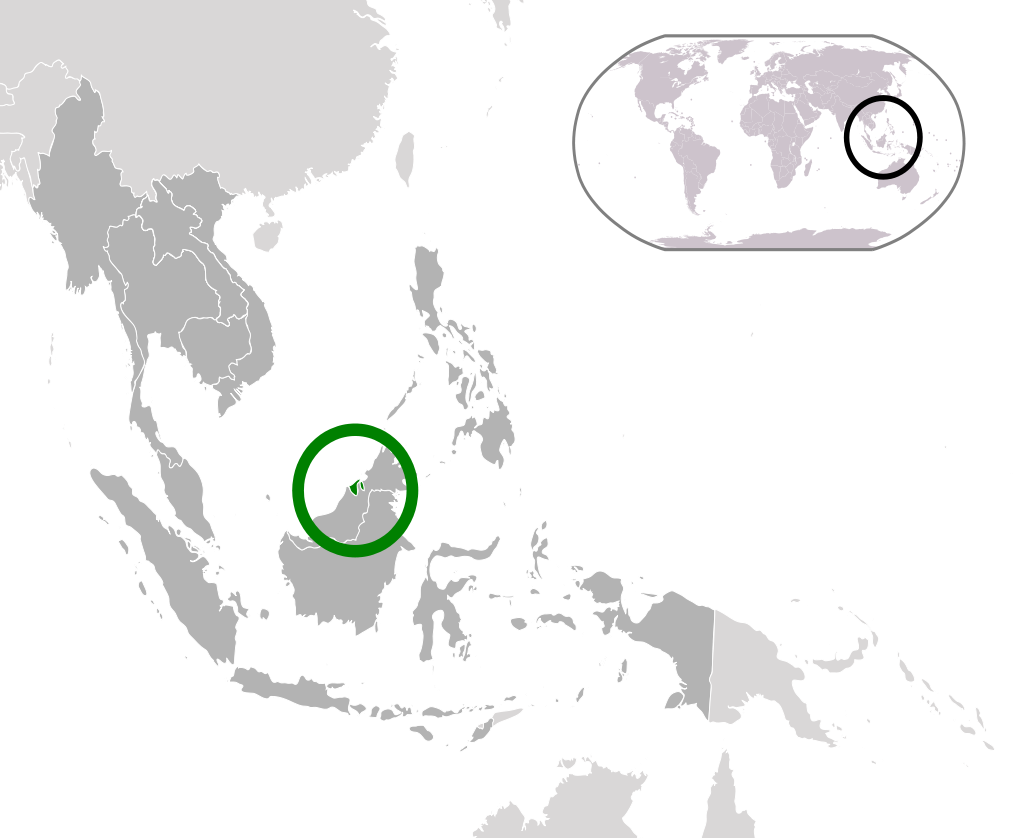
In this week’s episode of 80 Days, we are talking about Brunei, a tiny independent state of just 2,200 square miles, located on the north coast of the island of Borneo in Southeast Asia. Borneo is a tropical, equatorial island, one of the largest in the world, divided between Indonesia, Malaysia and Brunei. Brunei borders exclusively on the Malaysian section of Borneo. Its small section of coastline is inhabited by just over 400,000 people, and is among the richest nations in the world in terms of natural resources. Traditionally ruled by a Sultan, it became a British protectorate in 1888 and gained independence from the United Kingdom on January 1st 1984. Modern Brunei is ruled by a ‘Malay Islamic Monarchy’, where a Sultan acts as Supreme Head of State, ruling effectively as prime minister, finance minister, and commander of the armed forces. Brunei is the first and only country in East Asia to be ruled by Sharia law, introduced by the current Sultan in 2013. Your hosts are Luke Kelly@thelukejkelly, Mark Boyle@markboyle86 and Joe Byrne@anbeirneach, in Hong Kong, the UK and Ireland, respectively. (Theme music by Thomas O’Boyle)
There are some things we talked about you might want to know more about:
It is difficult to say much for certain about the important Chinese diplomat, trader or prince Ong Sum Ping (the local Hokkien pronunciation of 黃森屏, Huang Senping in Mandarin), but he was clearly an important figure in Brunei’s earliest history, arriving in the area around 1375, marrying into the family of 1st Sultan Muhammad Shah, and subsequently helping to repel an invasion from the Sulu islands. His exact role is often occluded in modern history perhaps because he was either not Muslim or not Malay. Some of the conflicting information and opinions can be found on Wikipedia, the Brunei Times, from blogs I’m Just Saying, and Nomadic Republic, and from Malaysian politician Lim Kit Siang
In 1521, Brunei was visited by the first voyage to circumnavigate the globe, the Magellan-Elcano Expedition and an account was kept by Antonio Pigafetta (an Italian and the historian on the ship) of their meeting with the Sultan: “The king to whom we presented ourselves is a Moor, and is named Raja Siripada: he is about forty years of age, and is rather corpulent. No one serves him except ladies who are the daughters of the chiefs. No one speaks to him except by means of the blow-pipe“
The Castillian War between the Spanish in Manilla and Brunei was a defining moment in 1578 when conflict over trade, religion and land led to military enagement between the Europeans and the Sultanate. In the end, disease played a large role in weakening the Spanish forces, hastening the Bruneian victory. Read about it on Brunei Resources (more from the same author in the Brunei Times), including the following quote:
Why did the Spaniards leave? According to Brunei legends, the Spaniards kept facing attacks organised by Pengiran Bendahara Sakam. The latter is seen as one of Brunei’s past folk heroes. He attacked the Spaniards with 1,000 men and defeated them. However, Western historians do not accept this version and deny that Bendahara Sakam even existed, preferring the version that the Spaniards left because of dysentery. According to the Spanish records, only 17 died of dysentery in Brunei and another six on the return to Manila, although a number of Filipinos also died. – Brunei Resources
A surprising character in the history of Brunei was Sir James Brooke (1803-1868), who after his exploits with the British East India Company’s Bengal Army and subsequent exploring ended up helping the Sultan crush a rebellion. He, and his heirs were given the province of Sarawak (later also taking Labuan) and became know as the “White Rajahs“; the podcast Stuff You Missed in History Class have an episode on the White Rajahs, which is worth a listen
The Brunei Revolt (1962) was an uprising by factions opposed the monarchy and to the prospect of union with Malaysia (including Brunei People’s Party) which was put down by British troops led by Lt Col Digby Willoughby (also a renowned bobsleigher); below is an image of the Queen’s Own Highlanders patrolling for rebels in jungle waterways near Brunei’s oil fields
A recent Borneo Bulletin article describes the first National Day after Brunei’s independence from the UK in 1984
In this week’s episode of 80 Days, we are talking about Gibraltar, the “key to the Mediterranean”. Famous for the imposing Rock of Gibraltar, this 6.7 square kilometre British Overseas Territory is an historic anomaly at the tip of the Iberian peninsula with a unique status and culture. It forms the northern side of the Pillars of Heracles which mark the beginning of the Atlantic Ocean. The tiny territory is also famous for its Barbary macaques, the only wild monkey population in Europe. Your hosts are Luke Kelly@thelukejkelly, Mark Boyle@markboyle86 and Joe Byrne@anbeirneach, in Hong Kong, the UK and Ireland, respectively. (Theme music by Thomas O’Boyle)
There are some things we talked about you might want to know more about:
Archaeological finds at Gorham’s Cave and other sites have given evidence that Neanderthals lived her until about 32,000 years ago – much more recently than had previously been expected. It is thought that this area was a lush Savannah climate at the time and very rich in food and resources. The BBC have a report from when the caves were granted UNESCO World Heritage status earlier this year.
The name Gibraltar comes from the Arabic Jabal Tariq (جبل طارق) named for Tariq ibn Ziyad who led the Moorish/Umayyad conquest of what is now Spain in the 710s; he had gathered his invading troops at the Rock of Gibraltar before pressing inland.
In 1706, when the English took the Rock during the War of Spanish Succession, nearly all of the inhabitants decamped to the City of Gibraltar in the Fields of San Roque, expecting a temporary stay. The Spanish city of San Roque is still there to this day and still features symbols of Gibraltar in its crest
Gibraltar’s status as an British territory was regularised, by Article X of the Treaty of Utrecht (1713)
The Catholic King does hereby, for himself, his heirs and successors, yield to the Crown of Great Britain the full and entire propriety of the town and castle of Gibraltar, together with the port, fortifications, and forts thereunto belonging; and he gives up the said propriety to be held and enjoyed absolutely with all manner of right for ever, without any exception or impediment whatsoever.
Crew of the HMS Wasp who demolished O’Hara’s Tower (O’Hara’s Folly)
New Statesman has an article describing the history behind the legends that tie the presence of the famous Barbary macaques to British control of the Rock
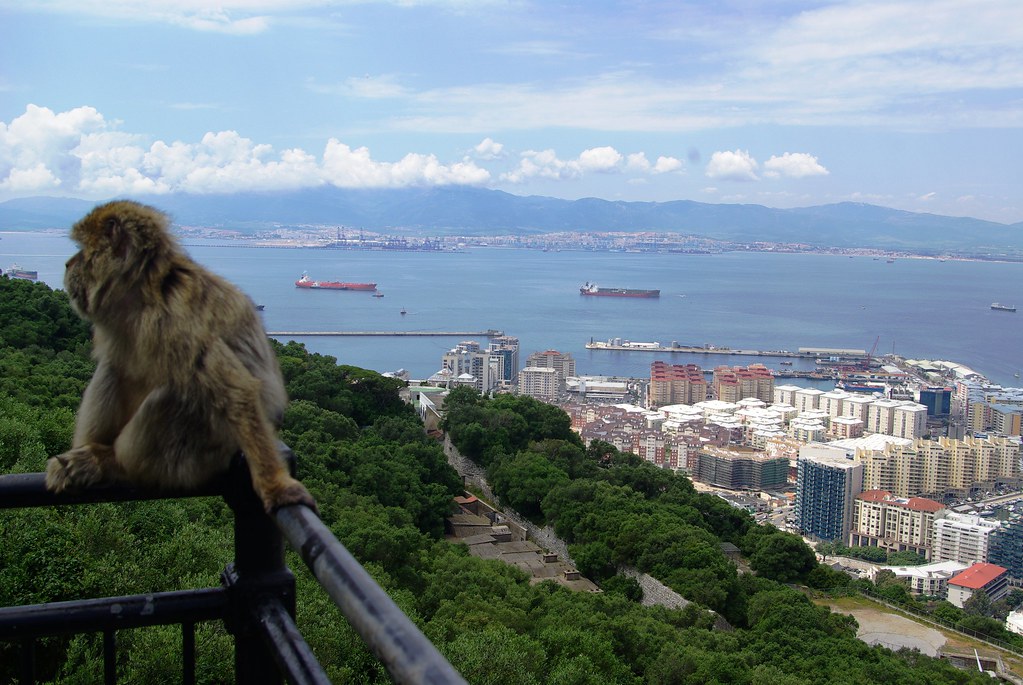
Photo of a “Barbary Ape” over Gibraltar by user kanu101 on Flickr
We spoke about the unusual airport that spans Gibraltar’s entire border with Spain and crosses the main street; there is a video on YouTube which shows the airport from above and a plane taking off from its short runway
If you are interested in hearing Llanito, the English-Spanish creole spoken by some in Gibraltar, you can hear it spoken and discussed in this video of two men at a café.
A BBC report on the outcome of the 2002 Sovereignty Referendum gives some insight into the origins of the dispute and the implications of the results. 98% of Gibraltarians opposed the idea of “shared sovereignty” between Britain and Spain
If you liked hearing about the music of Gibraltar, check out Breed 77‘s song El Rio. Some songs that reference the Rock of Gibraltar are by Frankie Laine and Ella Fitzgerald.
During this period, there were also plans drawn up to use the extensive cave network to hide soldiers in, in the case of a German occupation of Gibraltar to observe and sabotage the Axis powers’ operations; this documentary discusses “Operation Tracer“
This week, 80 Days was featured in a post on Irish news-and-humour website Broadsheet.ie. The post focuses on the fact that the three of us who host 80 Days are originally from Ireland but now living around the world. It clearly resonated with other Irish people in similar situations, because along with a big increase in website traffic and listeners from Ireland, this week, we’ve had a surge of interest from all around the globe, the US, UK, Japan, China and more. This is a link to the article: “Irish Men of the World“.
If you’re enjoying us telling stories about the world, then please subscribe to the podcast, tell a friend about it, or leave us a review on iTunes (or wherever you get your podcasts). And – as always – get in touch if you think there’s somewhere interesting we should be exploring soon.
In this week’s episode of 80 Days, we are talking about the Isle of Man, a small island in the Irish sea that lies right between Britain and Ireland. From its highest point Snaefell (620 m, 2034 ft), it is said you can see 6 kingdoms: England, Ireland, Wales, Scotland, Man and Heaven. It’s known for its rugged landscape, motorsport and a very curious flag. Today, the island is a British crown dependency although it has never been a part of the United Kingdom. It’s 85,000 inhabitants, 28,000 of whom live in the capital, Douglas, on the east coastare spread over the island’s 572 square kilometers. The Isle of Man’s fascinating history has made for a unique pocket of culture within the British isles, a place that has never been truly overcome by the powers surrounding it, and has always stood apart. Your hosts are Luke Kelly@thelukejkelly, Mark Boyle@markboyle86 and Joe Byrne@anbeirneach, in Hong Kong, the UK and Ireland, respectively. (Theme music by Thomas O’Boyle)
We are all Irish, but the Isle of Man, despite its proximity is really that neighbour we don’t know very well. Needless to say, we learned a lot this week about the smallest Celtic nation.
There are some things we talked about you might want to know more about:
Early history is best understood through archaeology from the stone age. We mentioned Mull Hill/Cronk Meayal (pictured below), where ancient shards of pottery and standing stones were found; we also mentioned Cashtal yn Ard; you can watch Standing with Stones discussing the ancient monuments of the Isle of Man on YouTube
Tynwald claims to be the oldest continuous parliamentary assembly in the world and largely consists of the directly elected House of Keys. At Tynwald Day (annually on 5th of July) laws are promulgated from a hill in St Johns. The Sword of State (which leads the procession on Tynwald Day each year) allegedly dates back to Olaf the Black
The Chronicle of Man and the Sudreys (early history of the Kingdom of the Isles in Latin with English translation) can be read here, while a version of Njal’s Saga which deals with the Battle of Clontarf in Dublin and the Manx brothers who fought on opposite sides can be found here
We also mentioned that the Isle of Man was once part of the Archdiocese of Dublin; the homepage of Francis Street Parish describes the “manx emblem” decorating the church, reflecting this history
The Camp – a newsletter from the World War 2 Hutchinson Internment Camp – can be read on archive.org
A book of Manx Ballads and Musicedited by Arthur William Moore (1896) includes a wonderful introduction, maligning the music itself with passages like the following: “It will be observed that their authors, the majority of whom are clearly illiterate men, are occasionally quite indifferent to the exigencies of either metre or rhyme.” Some of the songs are charming. The Arrane Oie Vie/Good Night Song can be found on manxmusic.com
And finally, the TT (Tourist Trophy motorcycle race) is probably the thing the Isle of Man is most famous for. It’s fast, dangerous and unique and its madness is probably best demonstrated by a video, like this one of Guy Martin and Michael Dunlop racing at speeds of up to 200 mph on public roads
This week in 80 Days, we looked at Liberia, a small country on the west coast of Africa. Founded by freed American and Caribbean slaves, Liberia is Africa’s oldest republic and takes its name from the the Latin phrase meaning “Land of the Free.” Unfortunately, the country is best known for a long and bloody civil war that look place in the 1990s and 2000s, and more recently for the Ebola epidemic of 2014. The lush, rainforested country is just 700 kilometres or 430 miles north of the equator, and is bordered by Sierra Leone to its west, Guinea to its north and Ivory Coast (Côte d’Ivoire) to its east. Today, the country is home to around 4.5 million inhabitants, although most are native Africans rather than the descendants of freed slaves. It maintains strong ties to America, and even has a flag that strongly resembles the flag of the US, although it has only one star and 11 stripes. Discussing Liberia are Luke Kelly@thelukejkelly, Mark Boyle@markboyle86 and Joe Byrne@anbeirneach in Hong Kong, the UK and Switzerland, respectively. (Theme music by Thomas O’Boyle)
We thought when we researched Nauru previously that it was the most depressing place we would ever encounter. But we were wrong! Liberia is at the bottom end of most tables you want to be near the top in (GDP, communications infrastructure, life expectancy, infant mortality) and has suffered from all the plights you can expect in the region and more, all as a result of inequality, corruption, disease and civil war, but nonetheless, it has a unique story worth telling. Some sources which we found particularly useful in researching the episode were:
“VICE Guide to Liberia” – VICE sent a crew to Liberia in 2012 to look at the devastating effects of the civil war on life, particularly in the capital Monrovia. Features interviews with various former civil war generals, including General Bin Laden and General Butt Naked (who is now a Christian evangelist).
“Ebola in Liberia: An Epidemic of Rumours“: article by Helen Epstein in The New York Review of Books, December 2014. Deals with suspicion of government and conspiracy theories which complicated the reaction to the spread of the disease
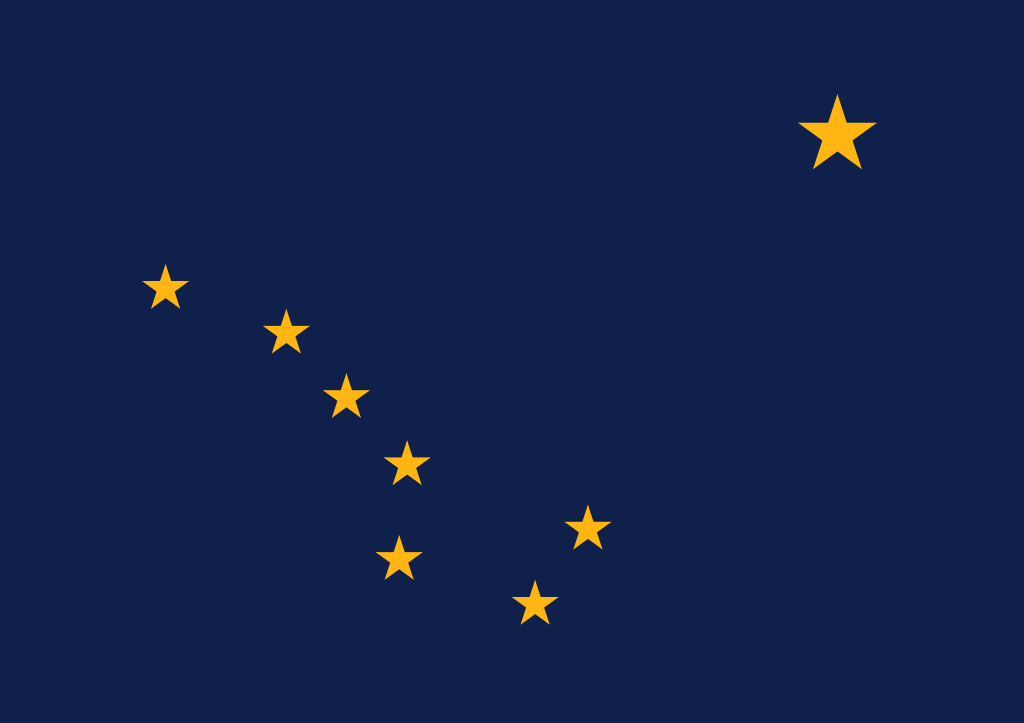
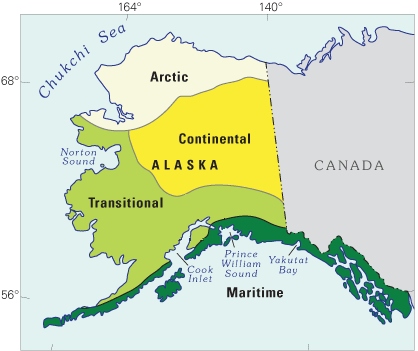
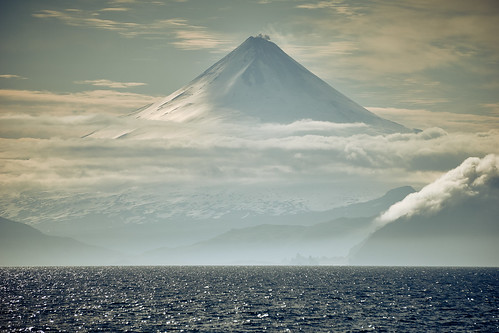
This week on 80 Days, we talked about Alaska, the United States of America’s 49th state. The name Alaska comes from the Aluet word Alyeska, meaning great land, and it is a plentiful place in many respects. Rich in natural resources, Alaska has a longer coastline than the other 49 states combined and is the largest state in the US. It contains over 3 million lakes, as well as Denali, North America’s highest peak. about 500 miles separates Alaska from Washington state, its nearest neighbour within the US, and it has a strong connection with Russia, which used to occupy and control the territory. Exploring Alaska for you are Luke Kelly@thelukejkelly, Mark Boyle@markboyle86 and Joe Byrne@anbeirneach in Hong Kong, the UK and Switzerland, respectively. (Theme music by Thomas O’Boyle)
Things you might want to read more about:
Alaska is the point of mainland America where it is generally considered humans first arrived in waves from Asia, including the ancestors of most indigenous South American peoples (25000-15000 years ago), the ancestors of many native Alaskan people and the Navajo and Apache Native American tribes (14000-9000 years ago), the ancestors of Aleut and Eskimo people (9000-6000 years ago). This makes the area valuable for archaeologists trying to understand how people came to the Americas. Alaska’s indigenous people (including Tlingit, Athabaskan, Innupiak, Aleut and others) and much of their culture still persists to the present day, although they were, of course, greatly affected by the intervening centuries of colonisation.
Potlach – a “competitive altruism” practice among some native communities, such as Athabaskans
Music this week is all from aboriginal North American people and can be found here and here
The first Europeans to arrive in Alaska were the Russians, who – in the course of charting the Pacific coast of Russia – crossed the strait which is now named after Vitus Bering, a Danish navigator who led a voyage across to what is now Alaska. There were violent clashes with native Aleuts and Tlingit people and disease had devastating consequences on the indigenous population. Bering himself was marooned on an island on the way back to Russia and died.
Fur-trapping, particularly of sea-otters, became the major economic interest of the Russians in “Russian America” and a monopoly was given to the Shelikhov-Golikov Company (later, the Russian-American Company), which set up headquarters at Sitka. This early settlement was attacked in the Battle of Sitka by the Kiks.ádi Tlingit clan.
Rather than lose their hard-to-defend province to the British in a war, the Tsar decided that the best course of action was to sell Alaska to the USA for $7.2m in 1867
We mentioned the instance of a Pope drawing a line on a map, which gave the Spanish a right to colonise some newly-discovered territories and the Portuguese others – this is dealt with in the Wikipedia article on the Treaty of Tordesillas
The Klondike Gold Rush brought tens of thousands of people north to the parts of Alaska bordering Yukon as gold was discovered in the rivers of this region. Many were ill-prepared and most unsuccessful in staking claims. Con man “Soapy” Smith was an interesting character in this period, depriving treasure seekers of their money through tricks, games and crime, until his eventual death at a famous shootout on Juneau Wharf
During World War 2, there was a lot of action in the Aleutian Islands, while US forces attempted to dislodge a Japanese force which had occupied; American propaganda during WW2 was remarkably racial in nature, describing Alaska as a “Death Trap for the Jap
The wealth generated by Prudhoe Bay and the other fields on the North Slope since 1977 is worth more than all the fish ever caught, all the furs ever trapped, all the trees chopped down; throw in all the copper, whalebone, natural gas, tin, silver, platinum, and anything else ever extracted from Alaska too. The balance sheet of Alaskan history is simple: One Prudhoe Bay is worth more in real dollars than everything that has been dug out, cut down, caught or killed in Alaska since the beginning of time
Here is a link to Sarah Palin’s endorsement of Donald Trump’s Presidential candidacy: see has an unusual use of language
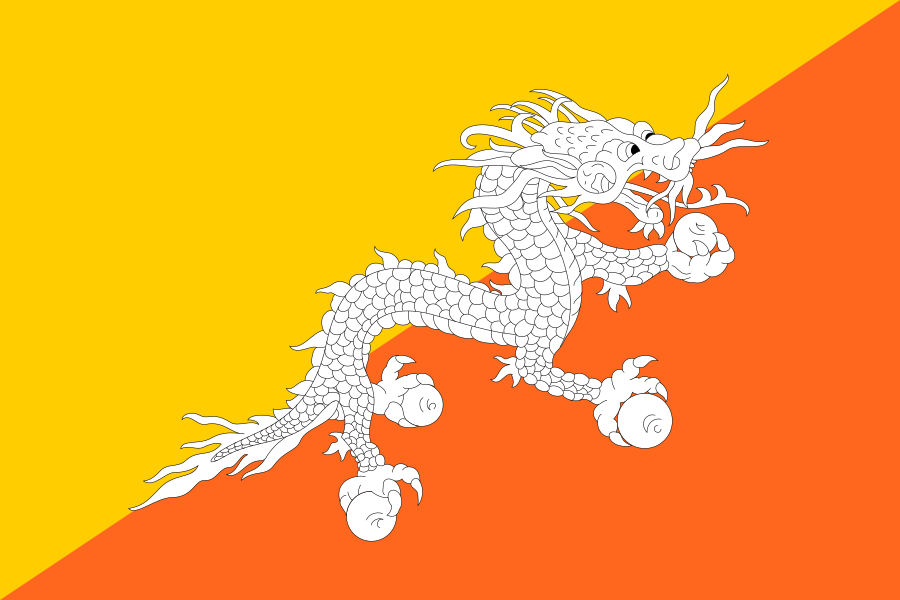
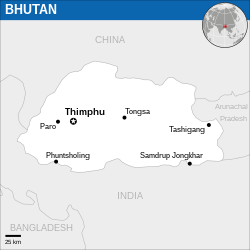
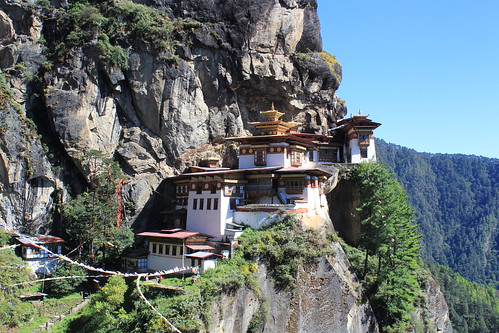
In this episode of 80 Dayswe’ll be talking about Bhutan a small, landlocked Asian nation with one of the best flags you’ll ever see. Bhutan is a country of less than a million people, bordered by the Tibetan region of China to the North and India pretty much everywhere else. Exploring Bhutan for you are Luke Kelly@thelukejkelly, Mark Boyle@markboyle86 and Joe Byrne@anbeirneach in Hong Kong, the UK and Switzerland, respectively. (Theme music by Thomas O’Boyle)
It’s the last of the Himalayan Buddhist kingdoms, which unlike Tibet and Sikkim has retained its independence. Also known as , the “Land of the Thunder Dragon” due to the prevalence of the Drukpa Lineageschool of Buddhism (aka the Dragon People). Bhutan is a strongly Bhuddist country, which remained and cut off from the outside world for much of its history. It is one of only a few countries to have been independent throughout its entire history, never conquered, occupied, or governed by an outside power. Since opening its borders to tourists in the 1970s, Bhutan has embraced democracy and now it famously promotesthe concept of gross national happiness which is reflected in the Bhutan Gross National Happiness Index.
Drukpa Kunley was a “divine madman” and beloved “patron saint” of Bhutan, who wielded a euphemistic “flaming thunderbolt” is worth reading more about – he is an unexpected lewd and drunken hero in a tradition often seen as mild-mannered and serene
Tibet, Buddhism and Bhutan – podcast by r/askhistorians dealing with the era where the Zhabdrung came to Bhutan from Tibet in the 1600s, unifying the country
National Geographic article including photographs of the coronation of the first Dragon King, Ugyen Wangchuck, taken in 1907 by British colonial administrator John Claude White, who was based in Sikkim at the time, accompanied by his accounts of the people, place and culture he saw
When TV Came to Bhutan – BBC Witness program about the change that came in 1999 when TV was introduced to the kingdom, discussing the effects with people who remember it
Fast Forward into Trouble – 2003 article in The Guardian about introduction of TV and changes to the society; this article really emphasises increases in crime
We mentioned how in the post-internet Bhutan, some Buddhist teachers now have a Facebook presence to exist in the modern world – one example is Venerable Lhalung Sungtrul Rinpoche, the current incarnation of the Terton Pema Lingpa (an associate of Guru Rinpoche)
Bhutan is no Shangri-La by Vidhyapati Mishra, writing in the New York Times writing about the experiences of the ethnic Nepali Lhotshampa refugees who were forced out of Bhutan in the 1990s
This Country Isn’t Just Carbon Neutral – It’s Carbon Negative – a TED talk by Bhutan’s Prime Minister Tshering Tobgay; as well as interesting details about Bhutan’s environmental policies, Tobgay gives insight into how modern Bhutan sees its place in the world and the importance of its culture and traditions


 Paraguay
 Gabon
Gabon Paris Catacombs

 Québec
 Jersey


 San Marino
 New Caledonia


 Turkmenistan
 Minisode: Natal, 1497
 Minisode: Runnymede, 1215
 Minisode: Hong Kong Invasion, 1941


 Liechtenstein
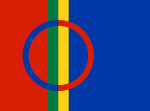 Lapland (Christmas Special)
 Namibia
 Nauru
Nauru Panama
 Bhutan
 Liberia
 Isle of Man
 Gibraltar







 We thought when we researched Nauru previously that it was the most depressing place we would ever encounter. But we were wrong! Liberia is at the bottom end of most tables you want to be near the top in (GDP, communications infrastructure, life expectancy, infant mortality) and has suffered from all the plights you can expect in the region and more, all as a result of inequality, corruption, disease and civil war, but nonetheless, it has a unique story worth telling. Some sources which we found particularly useful in researching the episode were:


 80 Days