After a long wait, it’s time for an update on Season 3 of 80 Days: an exploration podcast! There are a few announcements about the future release schedule, some teasers of things to come and all the details about our new Patreon page, where you can sign up to support this podcast if you like what we do: www.patreon.com/80dayspodcast
You can support us at lots of different levels from $1 per episode up to $10 per episode, depending on what kind of rewards you want to benefit from.
The show will always be free, but we’d really appreciate any pennies you can throw or way to help cover the costs of making it possible. We’re looking forward to sending out episode 1 of season 3 next week – the Australian Island of Tasmania.
Good news! Your favourite podcasters (we know we’re your favourite) have been listed among the Best Geography Resources by Tutorful, based on recommendations of their subscribers. We’re top of the list, too!
Thanks to all of you who’ve downloaded, listened, or liked the podcast, we couldn’t have done it without you.
Our second “minisode” focuses on the events that happened in Runnymede, England in 1215, when King John of England sealed a deal with his rebellious barons to bring some peace to his kingdom.
Thanks to Sam Hume from the History of Witchcraft Podcast for lending us his voice to give life to King John. Music this week comes from Lee Rosevere, and is used under Creative Commons License 3.0 (by attribution).
Merry Christmas from the 80 Days team! We hope you enjoy this Christmas themed “minisode” – this is a new, shorter and more focused format of episode we’re trying out before we launch Season 3. We’d love to hear your thoughts on this different style of storytelling (positive or negative), or indeed we’d love to hear your thoughts on anything on Facebook, Twitter or Instagram @80dayspodcast or by email at 80dayspodcast@gmail.com
Best wishes for 2018, wherever you are around the world.
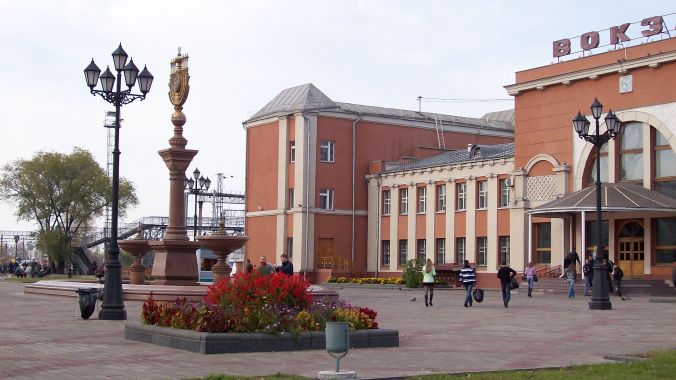
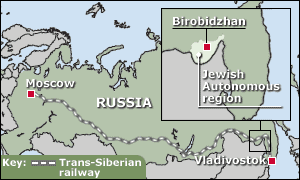
In this episode of 80 Days: An Exploration Podcast, we’ll be discussing the Jewish Autonomous Oblast (JAO), a somewhat independent region in the Russian Far East wedged between Siberia and Northern China. Its capital is the city of Birobidzhan, and with 75,000 inhabitants it is by far the most populated part of the region. For that reason, the name Birobidzhan is often used to refer to the whole area.
Officially founded in 1934 as an attempt to create a Jewish state within Russian borders, the territory was the world’s first attempt at a Jewish national homeland in modern times, and today is Russia’s only autonomous oblast. Aside from Israel, it is the world’s only officially Jewish territory. As of the 2010 Census, JAO’s population was 176,558 people, or 0.1% of the total population of Russia. Judaism is practiced by only 0.2% of the population of the JAO.
Some sources and further reading for this episode;
Masha Gessen’s Where The Jews Aren’t was the basis for this commissioned episode, you can find it on Amazon here, or listen to the author talk about it on NPR’s Fresh Airhere
If you’re interesting in learning more about Stalin in particular, you can check out our episode from earlier this season on Georgia, birthplace of “Joe Steel”.
Thanks to Louise Ireson, John Killeen, Simon Greene for your support on Kickstarter. Thanks too to Rabbi Eliyahu Riss in Birobidzhan for interviewing with us.
We also need to thank our sponsor for the season Hairy Baby, who in addition to making the funniest Irish-themed t-shirts, have also produced the official 80 Days shirt for our supporters. Find it by clicking here. You can get 10% off anything on www.hairybaby.com by using our promo code “80DAYS”.
This will be the final episode for this season, but never fear, we’ll be back with more obscure goodness soon. We’re extremely grateful to everyone who’s supported us over the past year and a bit of podcasting, and if you want to hear more stay subscribed to the feed and keep an eye on Facebook, Twitter and Instagram.
In this episode of 80 Days: an exploration podcast, we’ll be talking about Liechtenstein, a tiny European principality, sandwiched between Switzerland and Austria that is still ruled by the same family since the early 18th century. In a small valley towards the beginning of the mighty Rhine river, it was frequented by the Romans and incorporated into the empire before that all went sideways and the Vandals earned their name. After passing through the infuential spheres of central Europe through the centuries they were eventually taken over by the Liechtenstein family in a bid to get more favor with the Austro-Hungarian Empire (which worked a treat as it happened.) They side-stepped the devastation of World War 2 and spent the latter half of the 20th century becoming a financial services powerhouse, while also making a surprisingly successful go of manufacturing – dentures and drills in particular. Builders drills. Not dentists drills. Though there’s a business plan in there somewhere.
Liechtenstein – strong contender for the nicest place we’ve profiled. Apologies to Liberia…
In a break from our normal desktop research, we sent the intrepid Joe Byrne into the field with the savage Liechtensteiners to risk his life in doing some field research. Turns out it’s super safe and lovely. Who knew? Well you did if you listened in, as well as the chilled out nature of the locals and how normal it is to just run into some royalty if you live there.
Proof of Joe’s expedition below-
That’s Joe there, showcasing the Liechtenstein flag like a boss.
This slideshow requires JavaScript.
Above are a selection of photos from Liechtenstein, including the Roman ruins and the bronze Celtic figurines discussed in the episode. More photos can be seen here.
Here are some HOTLINKS (guitar solo here) to give you all the extra background you apparently weren’t sufficed with in our mega-bumper podcast, you info-hungry maniac:
Thanks to Sarah O’Farrell and Niall O’Leary for your support on Kickstarter and Sinéad Dowling who helped our man on the ground Joe Byrne with his visit and research. Thanks too to Martin Meier for a useful conversation and Donat Büchel, curator of the Liechtensteinische Landesmuseum for some assistance. Special thanks to students Julia and Sebbi from the Liechtensteinische Gymnasium (High School) for a long and informative interview – they make videos that can be found on YouTube.
Thanks too to our sponsor Hairy Baby, who in addition to making the funniest Irish-themed t-shirts, have also produced the official 80 Days shirt for our supporters. Find it by clicking here. You can get 10% off anything on www.hairybaby.com by using our promo code “80DAYS”.
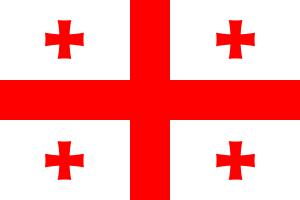
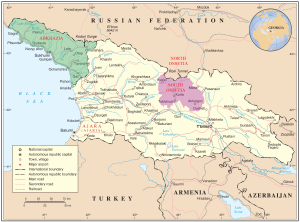
In this episode of 80 Days: an exploration podcast, we’ll be talking about Georgia. Not the US state, but the country in the south caucasus, known to its inhabitants as “Sakartvelo”. This former Soviet Republic is nestled between the Black Sea and the Caspian Sea, and is home to around 3.7 Million people with a history dating back thousands of years. Throughout its history, Georgia has been subject to numerous larger powers, including the Mongols, the Ottoman Empire, and dynasties of Persia (Iran) and the Soviet Union. As the Iron Curtain fell, Georgia declared its independence and has operated as a modern Republic ever since. It’s neighbour to the North, Russia, however, has ensured that Georgia’s hold over independence has never been as secure as most Georgians would like. Ethnic conflicts and economic turmoil beset the country throughout the 1990s, culminating in the brief Russo-Georgian war of 2008, from which tensions still remain to this day.
2002 article in Science describing the oldest discovered Homo erectus skull, found in Georgia
To get a grip on the expanding and contracting borders of Georgia over the centuries, there are two videos available on YouTube, showing changing maps: here, and here
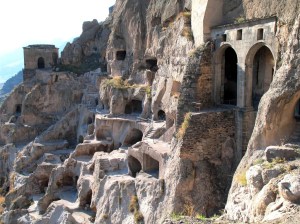
In 1185 Queen Tamar built remarkable thirteen-storey fortress cave city of Vardzia in the Erusheli Mtn, which looks like something out of Lord of the Rings(Atlas Obscura). It survived the coming of the Mongols, but an earthquake and a Shah more or less finished it off. Now some committed monks live there (see it on YouTube). There is also another rock-hewn city called Uplistsikhe which served as capital after Arab conquest of Tbilisi
“The History of the Mongols“ podcast gives a comprehensive view of the momentous impact of the Mongol expansion on vast reaches of the world, from China to the Caucasus; (iTunes link) Episodes “Tamerlane” and “Blood and Ink” might be of interest
The text of the last ultimatum from Muhammad Shah to King Erekle II (who was colluding with the Russians), along with various accounts of the related history can be found in the book “Edge of Empires: A History of Georgia” by Door Donald Reyfield (Google Books)
Finally, we promised to include the video of the insane baptism rituals available in the Georgian Orthodox Church, so from EuroNews, here it is:
A massive thanks to the inimitable Gary O’Daly and Jeffrey Dokar, two of the backers of our recent Kickstarter Campaign – thank you for making Season 2 possible. Big thanks also to Mariam Kalandarshvili for talking to us and helping us understand (and pronounce) some elements of Georgian history; we now know that the capital is T’bee-lee-see! Thanks too to our sponsor Hairy Baby, who in addition to making the funniest Irish-themed t-shirts, have also produced the official 80 Days shirt for our supporters. Find it by clicking here. You can get 10% off anything on www.hairybaby.com by using our promo code “80DAYS”.
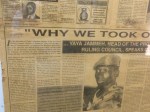
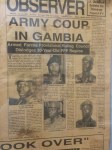
In this episode of 80 Days: an exploration podcast, we’ll be talking about the Gambia, the smallest country on the African mainland. Cutting a small sliver out of the Western coastline of Senegal, the Gambia is one of just a handful of nations on earth to share a border with just one country. The entirety of the country surrounds its namesake the Gambia River, with the border running parallel to both banks of the river inland for about 250 km. Gambia’s population of around 2 million is largely impoverished. It’s GDP is ranked at 167th out of 188 countries around the world, and like much of West Africa, it’s history has been impacted heavily by the slave trade. Having gained its independence in 1965 from the British empire, the Gambia has come to rely on its growing reputation as a tourist destination, and recently made headlines following a political power struggle between presidential candidates.
[02:01] Early exploration and the Stone Circles
[05:52] Influence of Islam and trade
[07:14] Mali and Songhai Empires
[09:43] Mandinka culture and scary masks
[18:07] Arrival of Europeans
[21:35] Start of trans-Atlantic slave trade
[26:15] First permanent European settlement
[26:55] Royal African Company founded in London
[30:26] Niall visits Nemban (clip)
[31:24] English and French vie for control
[35:01]The English liberalise the slave trade
[37:49] Pirate taking everything not nailed down
[39:20] Francis Moore’s reports
[42:32] The man who returned from slavery
[46:52] “Roots”
[49:59] Interview with tourguide
[53:24] Decline of the Royal African Company and searching for Timbuktoo
[55:38] Abolition of the slave trade and colony formation
[58:50] A colony for free slaves
[1:02:00] The kora and storytelling
[1:03:50] Setting the boundaries
[1:06:05] 20th Century, evolving colony and the world wars
[1:14:02] After the war… voting for all!
[1:16:45] Green Revolution and the PPP
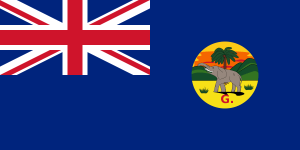
[1:20:00] An awful flag
[1:22:32] An attempted coup and Senegambia
[1:29:32] A new character enters the stage: Jammeh
[1:39:42] Jammeh’s home town
[1:44:32] The Magic Presidential Powers – “hard on AIDS, hard on witches”
[1:47:56] 2016 Election kerfuffle
[1:50:25] A new president elected
[1:55:43] Food, wildlife, tourism and sport
Here are a few things you may want to read/watch more about:
Article VIII of the Treaty of Utrecht deals with the right of Britain to sell slaves to the Spanish colonies
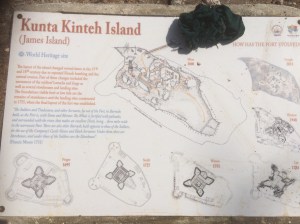
Kunta Kinteh Island (formerly James Island) is a popular tousist drawn, particularly because of the book (by Alex Haley) and TV series Roots (1977 series; 2016 remake)
“That Hell Hole of Yours” – article in American Heritage about FDR’s trip to Bathurst en route to the 1943 Casablanca Conference and his very critical impressions of colonialism
Music you heard was largely from field recordings by our friend Niall Ó Laoighaire (who is also responsible for most of the photos above, you may also want to listen to music from the following sources:
Music from the ‘griot’ performance with the ‘kora’ instrument was from a show of jali Alagi MBye – there are many videos of MBye on YouTube, including this one “The Kora Story“
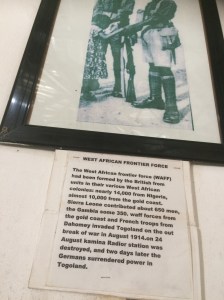
A massive thanks to John Keating and Lorraine Mounsey, two of the backers of our recent Kickstarter Campaign – thank you for making Season 2 possible. And special thanks this week to Niall Ó Laoighaire for his research in the Gambia, providing the photos above and some audio that you heard. Thanks too to our sponsor Hairy Baby, who in addition to making the funniest Irish-themed t-shirts, have also produced the official 80 Days shirt for our supporters. Find it by clicking here. You can get 10% off anything on www.hairybaby.com by using our promo code “80DAYS”.
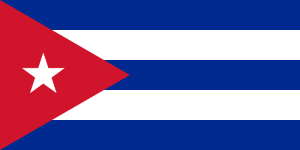
In this episode of 80 Days: an exploration podcast, we return to Cuba to bring its story from the Castro Revolution, right up to the modern day. As US-Cuba relations have been in the news this week, it’s impossible to keep up with all the twists and turns, but we do our best. If you haven’t already listened to Part 1 of this episode, we recommend listening to that first to see how we got here. Cuba is an island in the Caribbean Ocean, just 90 miles south of the US state of Florida. Cuba is home to over 11 million inhabitants. Cuba gained independence from Spain in 1902, but soon fell under US influence and became a playground for the rich and powerful; this was particularly true following the 1952 coup that brought Fulgencia Batista to power. Following a turbulent revolution which spanned almost the entire 1950s, the Communist Party of Cuba, under the leadership of Fidel Castro, took control of the country in 1965. Although poverty is widespread, modern Cuba has an outstanding health care and education system and relations with the US are currently beginning to thaw after a protracted embargo that has been in place since the 1960s. Since Cuba has an awful lot of history, particularly in the 20th Century, we decided to split this episode into two parts: this is the second part.
[02:20] Who is Fidel Castro?
[06:36] Castro starts his “July 26” Movement
[09:10] Exile in Mexico, meeting Che and the Voyage of the Granma
[12:28] Revolution!
[14:50] The ousting of Batista, victory for Castro
[17:38] Break
[18:12] Divisions within the revolution on the question of communism
[20:15] Courting the US, and the ‘communist closet’
[24:20] Che’s role in the world
[26:11] Refugees and Operation Peter Pan
[27:15] The Bay of Pigs invasion attempt
[35:26] US Trade Embargo begins
[36:57] The Cuban Missile Crisis – Armageddon averted
[44:00] Che leaves the stage
[46:03] ‘Castro really liked milk’, and other assassination attemps
[49:45] Cuba in the Soviet economic sphere – old cars
[51:42] “Los Frikis” punks
[52:42] Mariel Boat Lift
[54:03] Soviet Union falls, and the ‘special period’
[56:20] Medicine and oil
[58:31] Elian Gonzalez case
[60:21] Spies and political refugees
[61:07] Thawing of US-Cuba relations under Raul Castro
[64:10] What does the Pope have to do with this?
[65:30] Death of Fidel
[68:51] Trump’s evolving policies towards Cuba
[71:16] Sports! Baseball!
[73:00] Afro-Cuban traditions
[75:30] Some Cuban lunch
Here are a few things you may want to read/watch more about:
A massive thanks to Andrew Brogan and Crystal, two of the backers of our recent Kickstarter Campaign – thank you for making Season 2 possible. Thanks too to our sponsor Hairy Baby, who in addition to making the funniest Irish-themed t-shirts, have also produced the official 80 Days shirt for our supporters. Find it by clicking here. You can get 10% off anything on www.hairybaby.com by using our promo code “80DAYS”.









 80 Days