Shetland (S6.09)

Audio: Shetland

In this episode of 80 Days: An Exploration Podcast we’ll be talking about Shetland, a group of about 100 islands, fewer than 20 of them inhabited, in Scotland, 210 km (130 miles) north of the Scottish mainland, at the northern extremity of the United Kingdom, around 340km or 210 miles from Norway. The islands total around 1,500 km2 (or 560 sq mi), making them similar in size to the nearby Faroe Islands [recommend listening to this past episode], American Samoa or Gran Canaria. 

Among the settlements on Mainland, the largest island, is Scalloway, a fishing port. Lerwick, also on Mainland, is the islands’ largest town and commercial and administrative centre. The early history of the islands is dominated by the influence of the Vikings, who settled here in the 9th Century. From the 14th century, it was incorporated into the Kingdom of Scotland, and later into the United Kingdom. The climate is generally windy, cloudy and often wet, with rain falling on more than 250 days a year, and average low temperatures a little above 1 °C (34 °F) in winter and around 14 °C (57 °F) in summer.

Shetland is as far north as St Petersburg, Russia, or Anchorage, Alaska, which makes the islands an ideal place to watch the northern lights, or as they’re known locally the ‘mirrie dancers’ while in summer there is almost perpetual daylight, a state of affairs known locally as the “simmer dim”.

We had a guest on the podcast this episode, local writer, tour-guide and podcasters Laurie Goodlad, who can be found on shetlandwithlaurie.com. Thanks to Laurie for her great contributions to helping us understand Shetland, only a fraction of which is included in the episode – if you’ve fallen in love with Shetland, much more can be found in her blog and podcast episodes.

Your hosts, as always, are Luke Kelly @thelukejkelly in Wexford, Ireland, Mark Boyle @markboyle86 in Toronto, Canada, and Joe Byrne @anbeirneach in Dublin, Ireland. Our theme music and other stings come from Thomas O’Boyle @thatthomasfella.

Map of Shetland Islands in Scotland by Finlay McWalter on Wikimedia Commons
A Shetland pony photographed by Ronnie Robertson (CC-BY)
The Prince of Wales set off a trend of Fair Isle jumpers, part of a general inter-war Northern Isles boost in knitting and garment industry

Some further reading material is provided below:

Music relevant to Shetland includes:


Thanks to all our patrons who support the show. We really appreciate your continued backing of us. If you want to join them, more information is available at www.patreon.com/80dayspodcast

Belize (S6.07)

Audio: Belize

In this episode of 80 Days: An Exploration Podcast we’ll be talking about the Central American country Belize, formerly known as British Honduras.  This small country on the Yucatan Peninsula. It is bordered by Mexico to the north, the Caribbean Sea to the east, and Guatemala to the west and south. This region was a stronghold of the Maya Heartland from around 1500BC up to the arrival of Europeans, namely the Spanish, in the 1600s. A tussle between Spain and Britain developed in subsequent decades, and Belize became a British colony in 1840, and a Crown colony in 1862, before achieving full independence in 1981. The country has an area of 22,970 square kilometres (8,867 sq mi) and a population of just over 410,000, making it similar in size to Wales, Djibouti or the US state of New Jersey, but the least densely populated nation in Central America. This is a very diverse place, ecologically, culturally and linguistically. The official language is English, but there are many other communities such as Maya, Garifuna, Creoles and even Mennonites, who speak a variety of tongues. Belize has over 400 islands or Cays off its coastline, as well as one of the world’s largest marine sinkholes, the Blue Hole, which is 318 m (1,043 ft) across and extends to a depth of 124 m (407 ft). The country also boasts the second largest barrier reef in the world after the one everyone’s heard of in Australia.

Your hosts, as always, are Luke Kelly @thelukejkelly in Wexford, Ireland, Mark Boyle @markboyle86 in Toronto, Canada, and Joe Byrne @anbeirneach in Dublin, Ireland. Our theme music and other stings come from Thomas O’Boyle @thatthomasfella.

Some further reading material is provided below:

Music relevant to Belize includes:


Thanks to all our patrons who support the show. We really appreciate your continued backing of us. If you want to join them, more information is available at www.patreon.com/80dayspodcast

Wellington, New Zealand (S6.06)

Audio: Wellington

LISTENER SURVEY

In this episode of 80 Days: An Exploration Podcast we’ll be talking about Wellington, New Zealand. Located at the south end of the country’s North Island, Wellington is the third largest city, and capital of New Zealand. Māori oral tradition tells that Kupe discovered and explored the region in about the 10th century, before Maori people settled the country from around 1280, making New Zealand the world’s last major landmass to be occupied by humans. Maori named the natural harbour that forms here named the harbour Te Whanganui-a-Tara. As they tend to do, Europeans eventually showed up and began to colonise, in this case in the 1830s, inevitably coming into conflict with the Maori, and eventually renaming the settlement for Sir Arthur Wellesley, hero of Waterloo. Wellington was declared a city in 1840, and was chosen to be the capital city of New Zealand in 1865, making it the world’s southernmost capital of a sovereign state. Today, Wellington is home to around 420,000 people, giving it a similar population to Oakland, California or Manchester, England. It is well-known for its coffee culture, its natural beauty, its booming film industry and its extreme winds. Wellington is the world’s windiest city, with an average wind speed of 27 km/h (17 mph)

Your hosts, as always, are Luke Kelly @thelukejkelly in Dublin, Ireland, Mark Boyle @markboyle86 in Toronto, Canada, and Joe Byrne @anbeirneach in Dublin, Ireland. Our theme music and other stings come from Thomas O’Boyle @thatthomasfella.

We also had a huge amount of help from Thomas Rillstone for this episode. He’s the legend behind the History of Aotearoa New Zealand Podcast. You should check out his show for far more info on New Zealand than we could ever hope to know, and for much more accurate pronunciations than we could ever manage.

Some further reading material is provided below:

  • We referred a number of times in this episode to the official government site on Wellington’s history, which you can find here.
  • Another great source is the Wellington Museum. Did we mention there’s a lot written down in this one? The episode was well over three hours before it was edited!
  • There’s also an episode of Absolute History all about the history of the city, which touches on some of the points we made and also gives a good tour around the city. Featuring Peter Jackson!
  • We also recieved an absolute treasure trove of info from the good people of r/Wellington.
  • More info on Te Rauparaha and the Ngāti Toa can be found here.
  • The Radio New Zealand Black Sheep Podcast was a fantastic overview of the dastardley Wakefield clan and their misdeeds — check it out.
  • Want more on the Treaty of Waitangi? See here.
  • The Wakefield Memorial we discussed has its own Wikipedia page. It doesn’t improve the memorial much.
  • For more on the Musket Wars, check out Kiwi Codger on YouTube
  • Thomas Le Bas’ The Lost History of the Flag of Wellington is available on Medium.
  • More info on the Wahine Disaster is available on the official government site, and you can find news coverage from the period on YouTube.
  • For anyoen who hasn’t seen the All-Blacks perform the Haka before — check this out.
  • The Flat White? Wellington all the way.

Music includes:


Thanks to all our patrons who support the show. We really appreciate your continued backing of us. If you want to join them, more information is available at www.patreon.com/80dayspodcast

Hawaii (S5.09)

Audio: Hawaii

In this episode of 80 Days: An Exploration Podcast, we’ll be talking about Hawaii, and specifically the Big Island of Hawaii. Which is also called Hawaii.

Hawaii is the southeasternmost of the Hawaiian Islands, which make up the US state of Hawaii. The island makes up 63% of the archipelago’s landmass, but only 13% of its total population. The island is the third largest island in Polynesia, behind the two main islands of New Zealand. With a total area of around 10,000 km2 (or 4,000 square miles), Hawaii is similar in size to the islands of Puerto Rico or Cyprus, or our old friend Gambia.   

With a rich history and culture, Hawaii and its sister islands flourished as ancient societies, developing unique religions and customs, that is until the arrival of one Captain James Cook. In 1779 the famous explorer made his second and final landing here, and would not make it off the island alive. By the end of the century, the islands came under the protection of the British Crown, and missionaries soon followed, changing island life forever. The 1800s brought modern developments and the consolidation of the Kingdom of Hawaii, but ended in the annexation of the territory by the United States, a controversial episode to this day. In 1959, Hawaii becomes the 50th State, now famous for tourism, spam and pineapples. Hawaii Island, also known simply as The Big Island, is today home to around 185,000 people, and due to ongoing volcanic activity, Hawaii is the only US state that is still growing.

Hawaii_map 

Hawaii-flag

Your hosts, as always, are Luke Kelly @thelukejkelly in Dublin, Ireland, Mark Boyle @markboyle86 in the UK, and Joe Byrne @anbeirneach in Galway, Ireland. Our theme music and other stings come from Thomas O’Boyle @thatthomasfella. Thanks to Kuʻu Kauanoe one of the hosts of the Offshore Podcast from Honolulu Civil Beat, for speaking to us for this episode – you will hear clips from her interview throughout.

1402px-Distant_view_of_the_suburbs_of_Hilo,_Hawaii,_1907_(CHS-427)

The city of Hilo in 1907

Some further reading material is provided below:

  • A great website for all things Big Island is Love Big Island, and is particularly useful for tourists wishing to visit, but also helped us with plenty of history.
  • Rethinking the Native Hawaiian Past By Kanalu G. Terry Young is available on Google Books.
  • For more on the Kapu system, see storymaps.com
  • Hawaii: The Aloha State By Robin Doak has a lot more on the process of annexation, which you can find on Google Books.
  • The Eisenhower Library has more on Hawaii’s journey to statehood, which you can find here.
  • Smithsonian Magazine has an excellent article on Liliʻuokalani, the Last Queen of Hawaiʻi.
  • The Stuff You Should Know episode on the annexation is available here. Thanks, Josh and Chuck!
  • Richard B Frank’s article in TIME, headlined How Hawaii’s Japanese Population Was Spared Internment During World War II was a key source for that section of the show.
  • For more on the totally not supervillian Starfish Prime, you can check out this article in Discover Magazine.
  • Hawaii Beef also has lots of info on cattle farming on the islands.
  • Finally, the season of the Offshore Podcast on race relations in Hawaii can be found here. It’s definitely worth a listen.

green-sand-beach-hawaii-pictures
Check out that green sand!

The music used in this episode is as follows:


Thanks to all our patrons who support the show. We really appreciate your continued backing of us. If you want to join them, more information is available at www.patreon.com/80dayspodcast

Nepal (S4.08)

S04E08 Nepal Audio

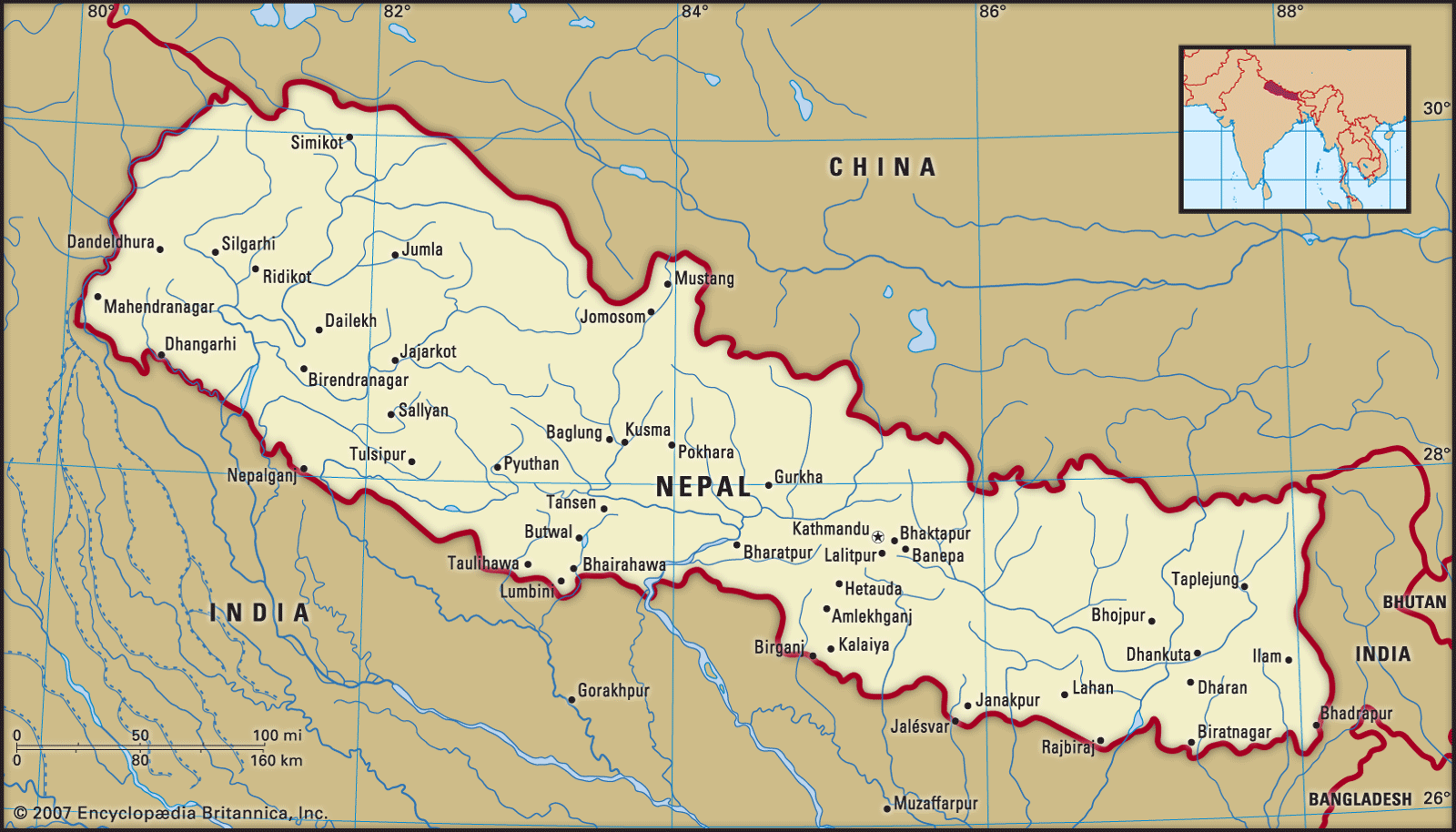
In this episode of 80 Days: An Exploration Podcast, we’ll be talking about Nepal, a small, landlocked country in South Asia. Nepal borders China in the north, India in the south, east and west, and Bhutan is separated from it by the Indian state of Sikkim. Home to eight of the world’s ten tallest mountains, including Mount Everest, this small nation has an expansive and complex history, and was only declared a republic in 2008.

Nepal-map-boundaries-cities-locator

Today Nepal is home to over 28 million people, and has a total land area of around 147,000 square kilometres or 56,000 miles, making it roughly the size of Greece, or the US state of New York. Aside from Everest, Nepal is famous for its strong military, exemplified by the Ghurkas, who played an important role in both world wars, as well as one of the world’s most recognisable flags.

This episode, just like all of our recent ones, is supported by our Patreon backers. If you want to help out the show, you can help out by joining us over on www.patreon.com/80dayspodcast to give us whatever you can in terms of financial support and avail of all the lovely awards and extras that entitles you to. If you’re unable to support us financially, you can always leave us a review on Apple Podcasts or wherever you get your podcasts from.
sujitabh-chaudhary-slkmvAwAWbk-unsplash

Parliament house of Nepal, Kathmandu – Sujitabh Chaudhary

sebastian-pena-lambarri-Wj9ELwGXa6c-unsplash

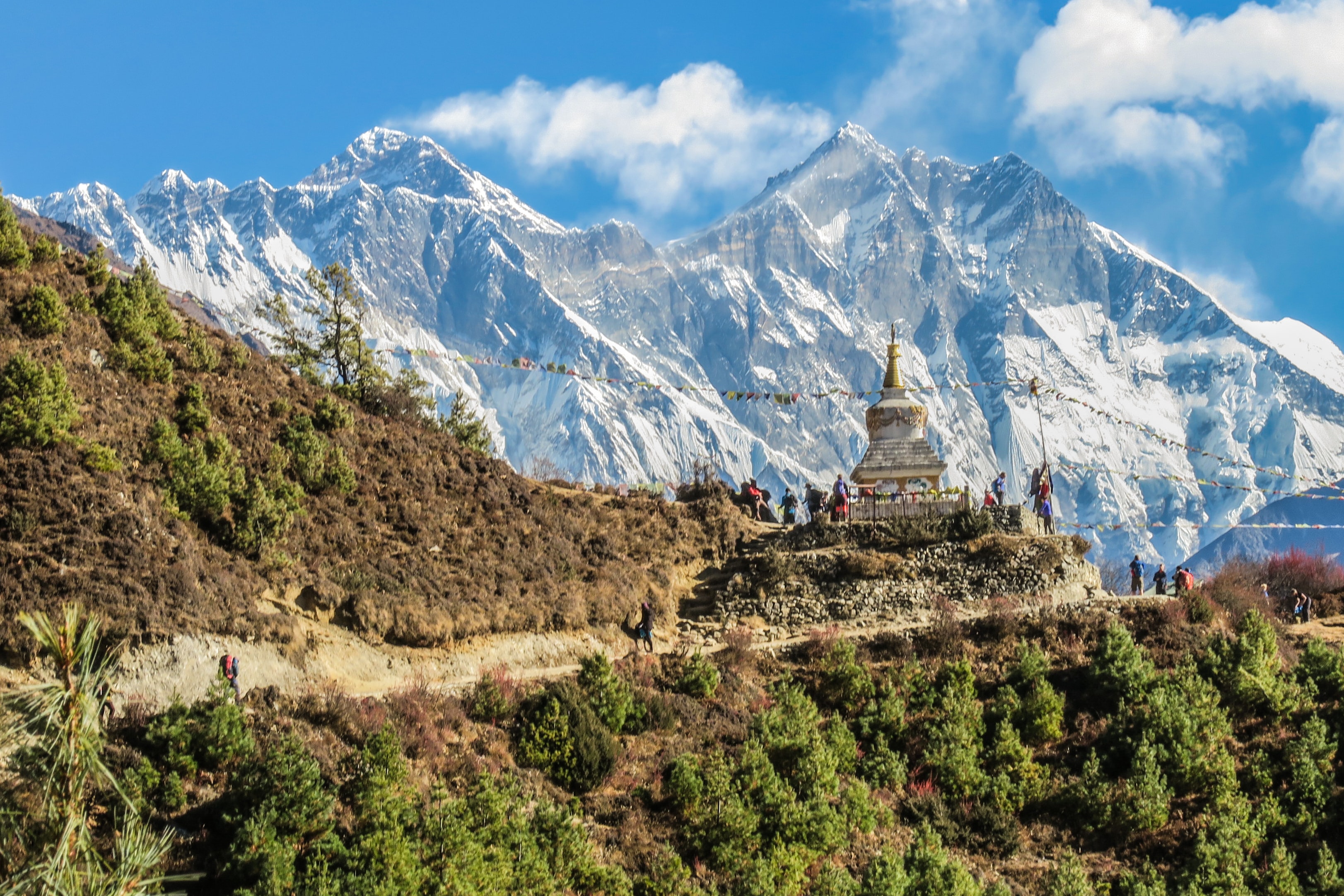
Namche Bazaar, Nepal – Sebastian Pena Lambarri

You can find more on the state flag of Ohio, which we discuss in this episode, here on Wikipedia.

Your hosts, as always, are Luke Kelly @thelukejkelly in Hong Kong, Mark Boyle @markboyle86 in the UK, and Joe Byrne @anbeirneach in Ireland . (Theme music by Thomas O’Boyle @thatthomasfella). We’d also like to thank Professor Lamont Lindstrom for his contribution to this episode. You can find more about him here.


Some further reading:

Music that might interest listeners: