Lapland or “Sápmi” (Christmas Special)

Christmas Special: Lapland audio

For the festive season, 80 Days brings you a Christmas special on the most appropriate place we could think of, complete with reindeer and Santa Claus: Lapland, or – as the native Sami people prefer to call it – Sápmi. This is a large region of Fennoscandanavia, north of the Arctic Circle, with its territory spanning parts of Finland, Norway, Sweden and Russia (see map). This episode will touch on all areas of Lapland, but will focus primarily on the Finnish and Norwegian sides. The area is named for the indigenous people (and their specific language grouping), who have sparsely inhabited the region for several thousand years. 

In Lapland, winter lasts from early October to early May, with temperatures well below freezing throughout the region and up to 60 cm or 23 inches of snow during midwinter. However, in summer the sun does not set on the region for several weeks at a time.  Population has declined quite significantly since 1990, and the region is now home to approximately 180,000 people. Residents are spread across a total area of just over 100,000 square kilometers, or 38,000 square miles, and there are as many reindeer here as there are people. Your hosts are Luke Kelly @thelukejkelly, Mark Boyle @markboyle86 and Joe Byrne @anbeirneach, in Hong Kong, the UK and Switzerland, respectively. (Theme music by Thomas O’Boyle)

File:Corrected Sapmi in Europe.PNGFile:Sami flag.svg

Some things you might like to know more about:

Toppkandidater Vesthavet valgkrets.jpg

File:Hram Sv Simeona Mirotočivog (Novi Beograd) 040.jpgFile:USMC-101208-M-8527P-077.jpg

  • A lot has been written about Lapland’s most famous resident and how he came to be here. Most of it is mysterious and people make some wild guesses (often not true), but here, in no particular order, are a few resources that might be useful about Santa Claus and his village near Rovaniemi, Finnish Lapland. Who is St. Nicholas (about his early years in Myra); Andrea McDonald’s account of visitingHistory of Santa Claus (on the-north-pole.com), Santa Claus and His Works (New York Times piece describing the contributions of artist Thomas Nast to the image of Santa’s snowy abode); Head to Finnish Lapland… (a 2009 article in the Independent, including descriptions of Santa’s village); Checking Out Santa’s Workshop in Lapland (a 1988 article in the LA Times describing visiting Santa in Rovaniemi). For the more cynical, a stuffy article on postmodernism and Finnish tourism policy can be found here (for all the Scrooges out there!).
  • You can often watch people visiting Santa live (or look back at earlier recordings) at this website, which is wonderfully magic

We hope you have a happy Christmas and a wonderful new year and that you are looking forward to joining us for Season 2 in the coming months. As always, please get in touch if you are enjoying what you are hearing or have anything to share with us!


Find out about our Christmas Kickstarter campaign by clicking here. With your help we can make Season 2 even better than Season 1!
(https://www.kickstarter.com/projects/80dayspodcast/80-days-podcast-season-2)

“The Bridge” Magazine

The Bridge Magazine

We are delighted to be included in this year’s edition of The Bridge, the alumni magazine from our alma mater Maynooth University. It will be arriving very shortly in the letterboxes of graduates all around the world. You can check out the article in full on page 20 of the magazine here. It’s a very nice write-up.

Irish Abroad Newsletter

80 Days was featured in November’s Global Irish Newsletter published by the Irish Government’s Department of Foreign Affairs (@GlobalIrish), which showcases achievements and news from Irish people worldwide. Commenting on the podcast, they said:

With special thanks to Joe, Luke and Mark. Their novel approach to learning about the world and sharing their insights is an excellent example of innovation and ties that transcend borders and continents. These qualities are hallmarks of the Irish diaspora and seeing that so well articulated in this podcast is great.

To read the full article, click here!

Kowloon Walled City (S1.10)

S01E10 Kowloon Walled City audio

For the Season Finale of the first season of 80 Days, we’re going to do something a little different and look at a place that no longer exists: Kowloon Walled CityOnce the most densely populated place in the planet, this unique, untamable settlement existed in Hong Kong, growing up from a military settlement which was originally built to demarcate the border between the British and Chinese controlled areas in the territory. It grew in size and scope to become a tightly-packed labyrinth of illegal activity and squalor, unregulated by either the Chinese or British governments. At its peak, over 30,000 people lived in the Walled City, resulting in a population density of approximately 1,255,000 inhabitants per square kilometre (3,250,000/sq mi). It was demolished in 1994, shortly before China retook control of Hong Kong, but has since become a cultural touchstone,  a fascinating example of what humanity can become when allowed to run unchecked. Your hosts are Luke Kelly @thelukejkelly, Mark Boyle @markboyle86 and Joe Byrne@anbeirneach, in Hong Kong, the UK and Switzerland, respectively. (Theme music byThomas O’Boyle)

A large solid block of ramshackle buildings varying in height, with many taller buildings and some mountains in the background.

Some things you might like to know more about:

  • The name Kowloon, given to the peninsula north of Hong Kong Island, comes from the Cantonese pronunciation of 九龍, Chinese for “Nine Dragons” (gau lung, or in Madarin Jiǔ ng); the name was given to it by the last Song Emporer, the 8-year-old Bing (), who saw the 8 mountains surrounding the place as “dragons”. A clever courtier pointed out that the Emperor was also a “dragon”, and hence there were 9. The story is told here in HK Magazine
  • We drew a few quotes and a lot of insight from Elizabeth Sinn’s article Kowloon Walled City: Its Origins and Early History” (Journal of the Hong Kong Branch of the Royal Asiatic Society, 1987, vol 27, p 30); for a more detailed account of this era, this article is recommended reading
  • When the Fortified City was built in 1846,  giant stone name plaques decorated the main gate to the city (reading , translated as Kowloon Walled City); they were excavated and can still be seen on the site today
  • The Opium Wars led to dramatic changes in this region of Qing China, with Hong Kong and later Kowloon falling into British hands through the  Peking Convention. Read further information about the wars from Julia Lovell (Birbeck, University of London) or Encyclopaedia Britannica
  • Mark came across a cannon from the ship Nemesis (the British East India Company’s first iron-clad warship) in the gardens of Windsor Castle; it is pictured below. More on the Nemesis from Victorian Web.

A cannon from the ship

This slideshow requires JavaScript.

  • Finally, here is some handheld camera footage by Rob Frost from the early 1990s inside the City:

We hope you enjoyed listening to Season 1. We’ll be taking a break for a couple of months to get production of Season 2 under way, but you may hear from us occasionally during the break. If you’ve been entertained by what you heard, then let us know – leave a review on iTunes (or wherever you listen), or get in touch on Facebook or Twitter. We also really welcome feedback about places we’ve explored and recommendations for where we should go next season.

Brunei (S1.09)

Audio: S1E09 Brunei

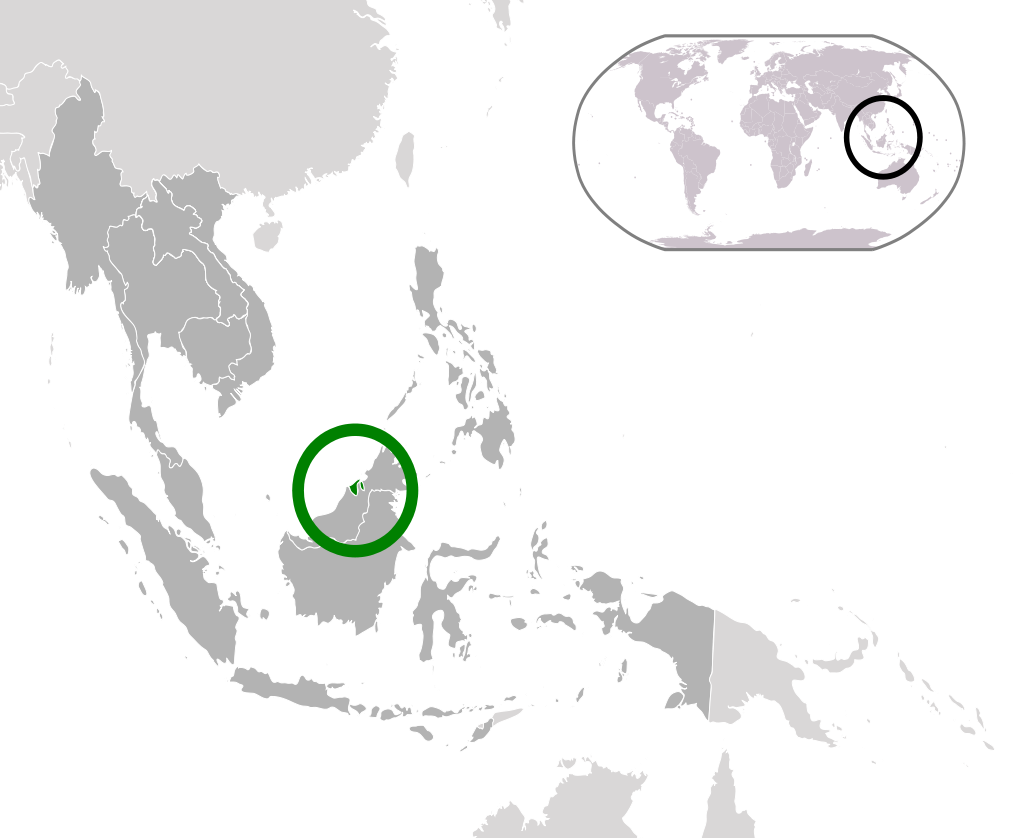
In this week’s episode of 80 Days, we are talking about Brunei a tiny independent state of just 2,200 square miles, located on the north coast of the island of Borneo in Southeast Asia. Borneo is a tropical, equatorial island, one of the largest in the world, divided between Indonesia, Malaysia and Brunei. Brunei borders exclusively on the Malaysian section of Borneo. Its small section of coastline is inhabited by just over 400,000 people, and is among the richest nations in the world in terms of natural resources. Traditionally ruled by a Sultan, it became a British protectorate in 1888 and gained independence from the United Kingdom on January 1st 1984. Modern Brunei is ruled by a ‘Malay Islamic Monarchy’, where a Sultan acts as Supreme Head of State, ruling effectively as prime minister, finance minister, and commander of the armed forces. Brunei is the first and only country in East Asia to be ruled by Sharia law, introduced by the current Sultan in 2013. Your hosts are Luke Kelly @thelukejkelly, Mark Boyle @markboyle86 and Joe Byrne @anbeirneach, in Hong Kong, the UK and Ireland, respectively. (Theme music by Thomas O’Boyle)


There are some things we talked about you might want to know more about:

  • It is difficult to say much for certain about the important Chinese diplomat, trader or prince Ong Sum Ping (the local Hokkien pronunciation of 黃森屏, Huang Senping in Mandarin), but he was clearly an important figure in Brunei’s earliest history, arriving in the area around 1375, marrying into the family of 1st Sultan Muhammad Shah, and subsequently helping to repel an invasion from the Sulu islands. His exact role is often occluded in modern history perhaps because he was either not Muslim or not Malay. Some of the conflicting information and opinions can be found on Wikipedia, the Brunei Times, from blogs I’m Just Saying, and Nomadic Republic, and from Malaysian politician Lim Kit Siang
  • In 1521, Brunei was visited by the first voyage to circumnavigate the globe, the Magellan-Elcano Expedition and an account was kept by Antonio Pigafetta (an Italian and the historian on the ship) of their meeting with the Sultan: “The king to whom we presented ourselves is a Moor, and is named Raja Siripada: he is about forty years of age, and is rather corpulent. No one serves him except ladies who are the daughters of the chiefs. No one speaks to him except by means of the blow-pipe
  • The Castillian War between the Spanish in Manilla and Brunei was a defining moment in 1578 when conflict over trade, religion and land led to military enagement between the Europeans and the Sultanate. In the end, disease played a large role in weakening the Spanish forces, hastening the Bruneian victory. Read about it on Brunei Resources (more from the same author in the Brunei Times), including the following quote:

Why did the Spaniards leave? According to Brunei legends, the Spaniards kept facing attacks organised by Pengiran Bendahara Sakam. The latter is seen as one of Brunei’s past folk heroes. He attacked the Spaniards with 1,000 men and defeated them. However, Western historians do not accept this version and deny that Bendahara Sakam even existed, preferring the version that the Spaniards left because of dysentery. According to the Spanish records, only 17 died of dysentery in Brunei and another six on the return to Manila, although a number of Filipinos also died. – Brunei Resources

Brunei1962IWM.jpeg

Gibraltar (S1.08)

Audio: S1E08 Gibraltar

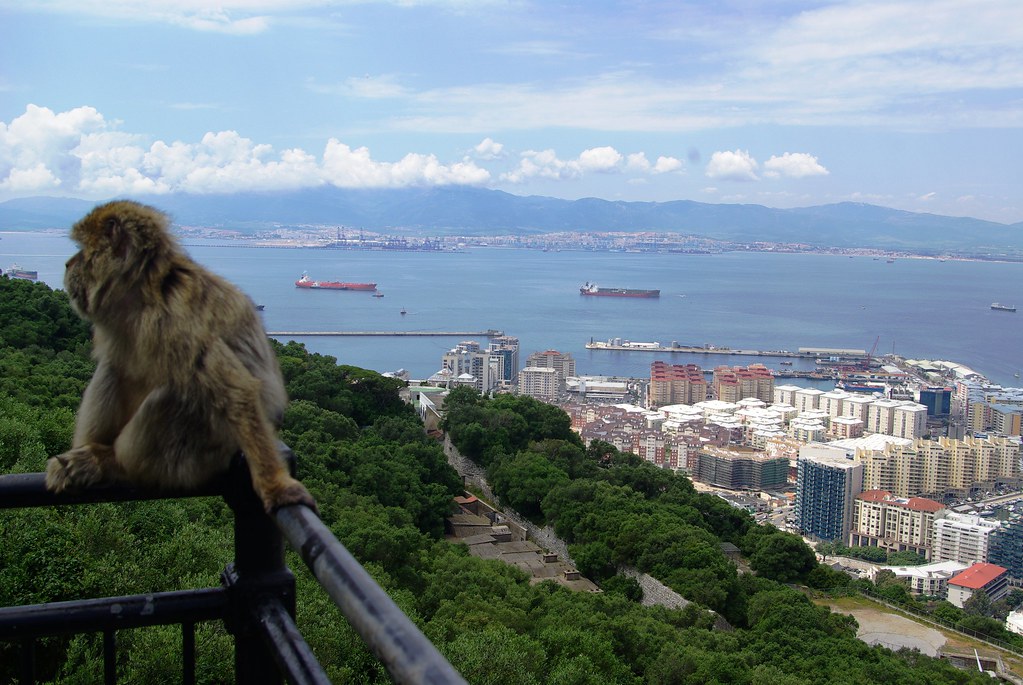
In this week’s episode of 80 Days, we are talking about Gibraltar the “key to the Mediterranean”. Famous for the imposing Rock of Gibraltar, this 6.7 square kilometre British Overseas Territory is an historic anomaly at the tip of the Iberian peninsula with a unique status and culture. It forms the northern side of the Pillars of Heracles which mark the beginning of the Atlantic Ocean. The tiny territory is also famous for its Barbary macaques, the only  wild monkey population in Europe. Your hosts are Luke Kelly @thelukejkelly, Mark Boyle @markboyle86 and Joe Byrne @anbeirneach, in Hong Kong, the UK and Ireland, respectively. (Theme music by Thomas O’Boyle)


There are some things we talked about you might want to know more about:

  • Archaeological finds at Gorham’s Cave and other sites have given evidence that Neanderthals lived her until about 32,000 years ago – much more recently than had previously been expected. It is thought that this area was a lush Savannah climate at the time and very rich in food and resources. The BBC have a report from when the caves were granted UNESCO World Heritage status earlier this year.
  • The name Gibraltar comes from the Arabic Jabal Tariq (جبل طارق) named for Tariq ibn Ziyad who led the Moorish/Umayyad conquest of what is now Spain in the 710s; he had gathered his invading troops at the Rock of Gibraltar before pressing inland.
  • In 1706, when the English took the Rock during the War of Spanish Succession, nearly all of the inhabitants decamped to the City of Gibraltar in the Fields of San Roque, expecting a temporary stay. The Spanish city of San Roque is still there to this day and still features symbols of Gibraltar in its crest
  • Gibraltar’s status as an British territory was regularised, by Article X of the Treaty of Utrecht (1713)

The Catholic King does hereby, for himself, his heirs and successors, yield to the Crown of Great Britain the full and entire propriety of the town and castle of Gibraltar, together with the port, fortifications, and forts thereunto belonging; and he gives up the said propriety to be held and enjoyed absolutely with all manner of right for ever, without any exception or impediment whatsoever.

Crew of the HMS Wasp who demolished O’Hara’s Tower (O’Hara’s Folly)

  • New Statesman has an article describing the history behind the legends that tie the presence of the famous Barbary macaques to British control of the Rock
View of Gibraltar with barbary ape

Photo of a “Barbary Ape” over Gibraltar by user kanu101 on Flickr

  • We spoke about the unusual airport that spans Gibraltar’s entire border with Spain and crosses the main street; there is a video on YouTube which shows the airport from above and a plane taking off from its short runway

80 Days featured on news site Broadsheet.ie

This week, 80 Days was featured in a post on Irish news-and-humour website Broadsheet.ie. The post focuses on the fact that the three of us who host 80 Days are originally from Ireland but now living around the world. It clearly resonated with other Irish people in similar situations, because along with a big increase in website traffic and listeners from Ireland, this week, we’ve had a surge of interest from all around the globe, the US, UK, Japan, China and more. This is a link to the article: “Irish Men of the World.

If you’re enjoying us telling stories about the world, then please subscribe to the podcast, tell a friend about it, or leave us a review on iTunes (or wherever you get your podcasts). And – as always – get in touch if you think there’s somewhere interesting we should be exploring soon.

14446457_10153823065410848_1190990000_o14446529_10153823112685848_301698549_o

Isle of Man (S1.07)

Audio: S1E07 Isle of Man

In this week’s episode of 80 Days, we are talking about the Isle of Mana small island in the Irish sea that lies right between Britain and Ireland. From its highest point Snaefell (620 m, 2034 ft), it is said you can see 6 kingdoms: England, Ireland, Wales, Scotland, Man and Heaven. It’s known for its rugged landscape, motorsport and a very curious flag. Today, the island is a British crown dependency although it has never been a part of the United Kingdom. It’s 85,000 inhabitants, 28,000 of whom live in the capital, Douglas, on the east coast are spread over the island’s 572 square kilometers. The Isle of Man’s fascinating history has made for a unique pocket of culture within the British isles, a place that has never been truly overcome by the powers surrounding it, and has always stood apart. Your hosts are Luke Kelly @thelukejkelly, Mark Boyle @markboyle86 and Joe Byrne @anbeirneach, in Hong Kong, the UK and Ireland, respectively. (Theme music by Thomas O’Boyle)

We are all Irish, but the Isle of Man, despite its proximity is really that neighbour we don’t know very well. Needless to say, we learned a lot this week about the smallest Celtic nation.

There are some things we talked about you might want to know more about:

Mull Hill Neolithic site

Mull Hill Neolithic site


Liberia (S1.06)

Audio: S1E06 Liberia

This week in 80 Days, we looked at Liberia, a small country on the west coast of Africa. Founded by freed American and Caribbean slaves, Liberia is Africa’s oldest republic and takes its name from the the Latin phrase meaning “Land of the Free.” Unfortunately, the country is best known for a long and bloody civil war that look place in the 1990s and 2000s, and more recently for the Ebola epidemic of 2014. The lush, rainforested country is just 700 kilometres or 430 miles north of the equator, and is bordered by Sierra Leone to its west, Guinea to its north and Ivory Coast (Côte d’Ivoire) to its east. Today, the country is home to around 4.5 million inhabitants, although most are native Africans rather than the descendants of freed slaves. It maintains strong ties to America, and even has a flag that strongly resembles the flag of the US, although it has only one star and 11 stripes. Discussing Liberia are Luke Kelly @thelukejkelly, Mark Boyle @markboyle86 and Joe Byrne @anbeirneach in Hong Kong, the UK and Switzerland, respectively. (Theme music by Thomas O’Boyle)

We thought when we researched Nauru previously that it was the most depressing place we would ever encounter. But we were wrong! Liberia is at the bottom end of most tables you want to be near the top in (GDP, communications infrastructure, life expectancy, infant mortality) and has suffered from all the plights you can expect in the region and more, all as a result of inequality, corruption, disease and civil war, but nonetheless, it has a unique story worth telling. Some sources which we found particularly useful in researching the episode were:

I would recommend you read, watch and listen to some of these sources if you want to learn more about the country than we could cram into the podcast.

Alaska (S1.05)

Audio: S1E05 Alaska

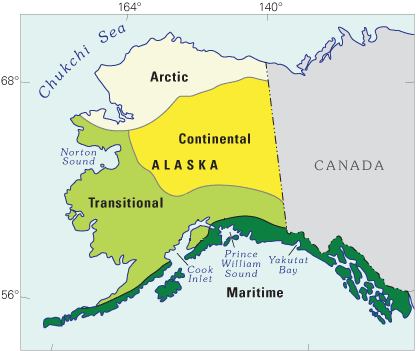
This week on 80 Days, we talked about Alaska, the United States of America’s 49th state. The name Alaska comes from the Aluet word Alyeska, meaning great land, and it is a plentiful place in many respects. Rich in natural resources, Alaska has a longer coastline than the other 49 states combined  and is the largest state in the US. It contains over 3 million lakes, as well as Denali, North America’s highest peak. about 500 miles separates Alaska from Washington state, its nearest neighbour within the US, and it has a strong connection with Russia, which used to occupy and control the territory. Exploring Alaska for you are Luke Kelly @thelukejkelly, Mark Boyle @markboyle86 and Joe Byrne @anbeirneach in Hong Kong, the UK and Switzerland, respectively. (Theme music by Thomas O’Boyle)

Flag of Alaska

Things you might want to read more about:

  • Alaska is the point of mainland America where it is generally considered humans first arrived in waves from Asia, including the ancestors of most indigenous South American peoples (25000-15000 years ago), the ancestors of many native Alaskan people and the Navajo and Apache Native American tribes  (14000-9000 years ago), the ancestors of Aleut and Eskimo people (9000-6000 years ago). This makes the area valuable for archaeologists trying to understand how people came to the Americas. Alaska’s indigenous people (including Tlingit, Athabaskan, Innupiak, Aleut and others) and much of their culture still persists to the present day, although they were, of course, greatly affected by the intervening centuries of colonisation.
  • Potlach – a “competitive altruism” practice among some native communities, such as Athabaskans
  • Music this week is all from aboriginal North American people and can be found here and here
  • Semyon Dezhnynov‘s expedition in the Bering Strait, which may have brought the first Russians to Alaska, although there are mixed opinions about this
  • The first Europeans to arrive in Alaska were the Russians, who – in the course of charting the Pacific coast of Russia – crossed the strait which is now named after Vitus Bering, a Danish navigator who led a voyage across to what is now Alaska. There were violent clashes with native Aleuts and Tlingit people and disease had devastating consequences on the indigenous population. Bering himself was marooned on an island on the way back to Russia and died.
  • Fur-trapping, particularly of sea-otters, became the major economic interest of the Russians in “Russian America” and a monopoly was given to the  Shelikhov-Golikov Company (later, the Russian-American Company), which set up headquarters at Sitka. This early settlement was attacked in the Battle of Sitka by the Kiks.ádi Tlingit clan.
  • Rather than lose their hard-to-defend province to the British in a war, the Tsar decided that the best course of action was to sell Alaska to the USA for $7.2m in 1867
  • We mentioned the instance of a Pope drawing a line on a map, which gave the Spanish a right to colonise some newly-discovered territories and the Portuguese others – this is dealt with in the Wikipedia article on the Treaty of Tordesillas
  • St Herman (the hermit) and St (Bishop) Innocent are two Russian Orthodox saints who were missionaries in the areas
  • The Klondike Gold Rush brought tens of thousands of people north to the parts of Alaska bordering Yukon as gold was discovered in the rivers of this region. Many were ill-prepared and most unsuccessful in staking claims. Con man “Soapy” Smith was an interesting character in this period, depriving treasure seekers of their money through tricks, games and crime, until his eventual death at a famous shootout on Juneau Wharf
  • During World War 2, there was a lot of action in the Aleutian Islands, while US forces attempted to dislodge a Japanese force which had occupied; American propaganda during WW2 was remarkably racial in nature, describing Alaska as a “Death Trap for the Jap

File:Alaska Death Trap.jpg