Ceuta (S6.10)

Audio: Ceuta

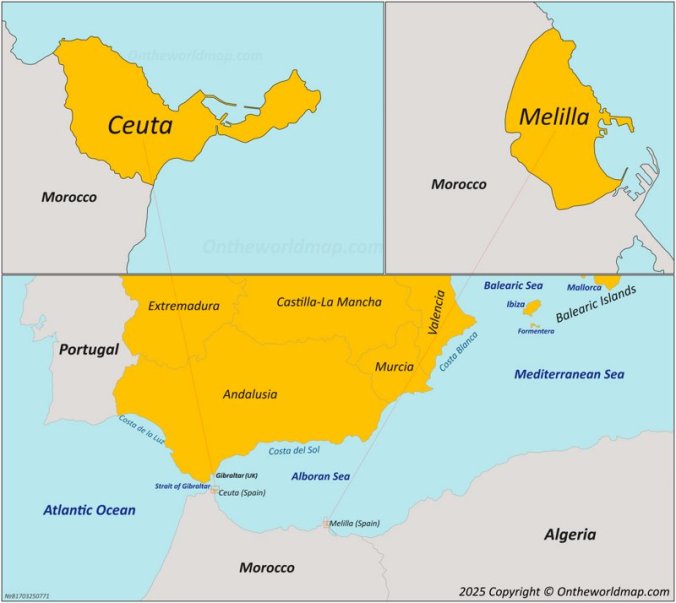
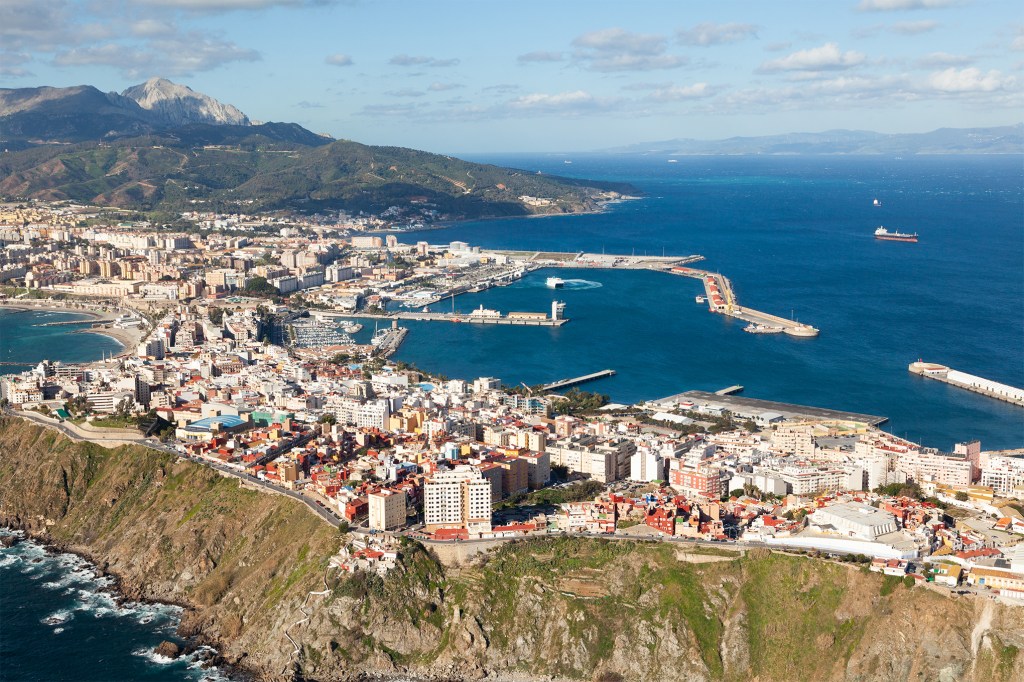
In this episode of 80 Days: An Exploration Podcast we’ll be talking about the autonomous city of Ceuta — Spanish exclave, military post, and free port on the coast of Morocco, at the Mediterranean entrance to the Strait of Gibraltar. Ceuta, Melilla (also an exclave), and other tiny islets along the coast of North Africa constitute the territories of Spanish North Africa. The city is on a narrow isthmus that connects Mount Hacho (also held by Spain) to the mainland. Mount Hacho has been identified as possibly the southern Pillar of Heracles, of the ancient Mediterranean world. Ceuta was controlled by the Muslim Umayyad Dynasty up to 1415, and then changed hands a number of times over the 15th and 16th Centuries. It played an important role in the Spanish Civil War, and gained its modern autonomous status in 1995. Ceuta’s land area is only about 18.5 square kilometres or 7 square miles, making it among the smallest places we’ve ever talked about, and has a population of around 80,000, similar to  Andorra, the Isle of Man or the US Virgin Islands. 

The climate here is warm but moderated by the straits, with mean annual temperatures of 18 °C (65 °F) with average highs of 21 °C (70 °F) and lows of 15 °C (60 °F). The currency is the Euro, and the language is Spanish, with a strong Arabic presence. 

Ceuta and Melilla are the only piece of EU territory on mainland Africa – a political and legal reality that has never been recognised by Morocco, which claims both territories to this day. 

Fun Fact – Western Sahara was a previously-Patreon-backed finale episode. You guys just have a real hankering for contentious North African territories, don’t you?

As we mention in the episode, this (somewhat delayed) finale to season 6 was voted on by our Patreon backers, and thanks as always to all of them for their support. You can sign up to Patreon to get a say in the episodes we cover in the seasons to come.

Your hosts, as always, are Luke Kelly @thelukejkelly in Wexford, Ireland, Mark Boyle @markboyle86 in Toronto, Canada, and Joe Byrne @anbeirneach in Dublin, Ireland. Our theme music and other stings come from Thomas O’Boyle @thatthomasfella.

Ceuta with Mount hacho visible in the background

Some further reading material is provided below:

  • This BBC Explainer on the status of Ceuta and Melilla is a good starting point for beginners. The BBC also has a useful factsheet.
  • This CNN feature headlined “Inside the tiny corner of Spain that lies in the middle of North Africa” is another useful primer.
  • History blog “A Small Part of History” has a lengthy post about the conquest of Ceuta by Portugal.
  • For a more visceral look at the city, this video travel guide of Ceuta from Travel Obscurer is worth checking out.
  • One of the many books we referenced in this episode was Europe or Africa? : a contemporary study of the Spanish North African enclaves of Ceuta and Melila by Peter Gold. It’s available on Archive.org.
  • We also spoke about Count Julian, whose Wikipedia page is well worth perusing.
  • Mark lent on A.R. Disney’s A History of Portugal and the Portuguese Empire – From Beginnings to 1807 for his section. You can find an excerpt here.
  • Another useful read was The Spanish Exclaves in Morocco by Robert Rézette, which is available on Google Books.
  • Anyone for a Wikipedia list of “People with the most children“? If you’ve heard Joe’s section, you’ll know why.
  • For more on Lieutenant John Fraser and his trusty leg bone, see the National Army Museum.
  • WebHispania has a fascinating blog post by Antonio M. Carrasco headlined The Ceuta border: a constant source of misunderstanding and conflict.
  • The UK’s National Maritime Museum has a whole page dedicated to Cueta in the Napoleonic Wars.
  • The UNHCR report on Anti-Muslim Hatred and Discrimination in Ceuta we mentioned is available here.
  • The substantial page on Wikipedia dedicated to the border fence is here. More can be found in World of Walls: The Structure, Roles and Effectiveness of Separation Barriers by Said Saddiki which is available online here.
  • On Franco and the Spanish Civil War, worth a read is The Crescent and the Dagger: Representations of the Moorish Other during the Spanish Civil War by Elisabeth Bolorinos Allard, available here.

Some of the music used in the episode includes:


Thanks to all our patrons who support the show. We really appreciate your continued backing of us. If you want to join them, more information is available at www.patreon.com/80dayspodcast

Socotra (S6.08)

Audio: Socotra

In this episode of 80 Days: An Exploration Podcast we’ll be talking about Socotra, an island in the Indian Ocean, lying between the Gulf of Aden and the Arabian Sea. It lies 380 kilometres (205 nautical miles) south of the Arabian Peninsula and 240 kilometres (130 nautical miles) east of Somalia. Geographically part of Africa, it has historically been an extremely isolated island due to the monsoon winds that make it difficult to reach for large parts of the year. This isolation has resulted in unique plant and animal life, with the island harbouring many species which went extinct elsewhere tens of thousands of years ago, and It has been described as “the most alien-looking place on Earth”
Over its history, the island has seen influence from Ethiopian Christians, Greeks, Arabs, Portuguese Explorers and the British East India Company, among others, and as a result has a unique blend of cultures and languages. The island is 3,796 km2 (1,466 sq mi) in size, making it similar in land area to the US state of Rhode Island, or slightly larger than Luxembourg. Around 50,000 people today call Socotra home, with the principal city, Hadibu, boasting around a fifth of the total population. The island became a part of Yemen in 1967,  and has recently been impacted by ongoing conflict caused by the Yemeni Civil War, which began in 2014 and is ongoing as we record this. In 2008, Socotra was recognised as a UNESCO World Heritage Site for its unique flora and fauna. The islanders rub noses when they are introduced, and primarily speak Soqotri, an ancient Semitic language, which has up to a hundred words to describe a goat.

Your hosts, as always, are Luke Kelly @thelukejkelly in Dublin, Ireland, Mark Boyle @markboyle86 in Toronto, Canada, and Joe Byrne @anbeirneach in Dublin, Ireland. Our theme music and other stings come from Thomas O’Boyle @thatthomasfella.

Some further reading material is provided below:

Music relevant to Socotra includes:


Thanks to all our patrons who support the show. We really appreciate your continued backing of us. If you want to join them, more information is available at www.patreon.com/80dayspodcast

Wellington, New Zealand (S6.06)

Audio: Wellington

LISTENER SURVEY

In this episode of 80 Days: An Exploration Podcast we’ll be talking about Wellington, New Zealand. Located at the south end of the country’s North Island, Wellington is the third largest city, and capital of New Zealand. Māori oral tradition tells that Kupe discovered and explored the region in about the 10th century, before Maori people settled the country from around 1280, making New Zealand the world’s last major landmass to be occupied by humans. Maori named the natural harbour that forms here named the harbour Te Whanganui-a-Tara. As they tend to do, Europeans eventually showed up and began to colonise, in this case in the 1830s, inevitably coming into conflict with the Maori, and eventually renaming the settlement for Sir Arthur Wellesley, hero of Waterloo. Wellington was declared a city in 1840, and was chosen to be the capital city of New Zealand in 1865, making it the world’s southernmost capital of a sovereign state. Today, Wellington is home to around 420,000 people, giving it a similar population to Oakland, California or Manchester, England. It is well-known for its coffee culture, its natural beauty, its booming film industry and its extreme winds. Wellington is the world’s windiest city, with an average wind speed of 27 km/h (17 mph)

Your hosts, as always, are Luke Kelly @thelukejkelly in Dublin, Ireland, Mark Boyle @markboyle86 in Toronto, Canada, and Joe Byrne @anbeirneach in Dublin, Ireland. Our theme music and other stings come from Thomas O’Boyle @thatthomasfella.

We also had a huge amount of help from Thomas Rillstone for this episode. He’s the legend behind the History of Aotearoa New Zealand Podcast. You should check out his show for far more info on New Zealand than we could ever hope to know, and for much more accurate pronunciations than we could ever manage.

Some further reading material is provided below:

  • We referred a number of times in this episode to the official government site on Wellington’s history, which you can find here.
  • Another great source is the Wellington Museum. Did we mention there’s a lot written down in this one? The episode was well over three hours before it was edited!
  • There’s also an episode of Absolute History all about the history of the city, which touches on some of the points we made and also gives a good tour around the city. Featuring Peter Jackson!
  • We also recieved an absolute treasure trove of info from the good people of r/Wellington.
  • More info on Te Rauparaha and the Ngāti Toa can be found here.
  • The Radio New Zealand Black Sheep Podcast was a fantastic overview of the dastardley Wakefield clan and their misdeeds — check it out.
  • Want more on the Treaty of Waitangi? See here.
  • The Wakefield Memorial we discussed has its own Wikipedia page. It doesn’t improve the memorial much.
  • For more on the Musket Wars, check out Kiwi Codger on YouTube
  • Thomas Le Bas’ The Lost History of the Flag of Wellington is available on Medium.
  • More info on the Wahine Disaster is available on the official government site, and you can find news coverage from the period on YouTube.
  • For anyoen who hasn’t seen the All-Blacks perform the Haka before — check this out.
  • The Flat White? Wellington all the way.

Music includes:


Thanks to all our patrons who support the show. We really appreciate your continued backing of us. If you want to join them, more information is available at www.patreon.com/80dayspodcast

Montserrat, Spain (S6.05)

Audio: Montserrat

LISTENER SURVEY

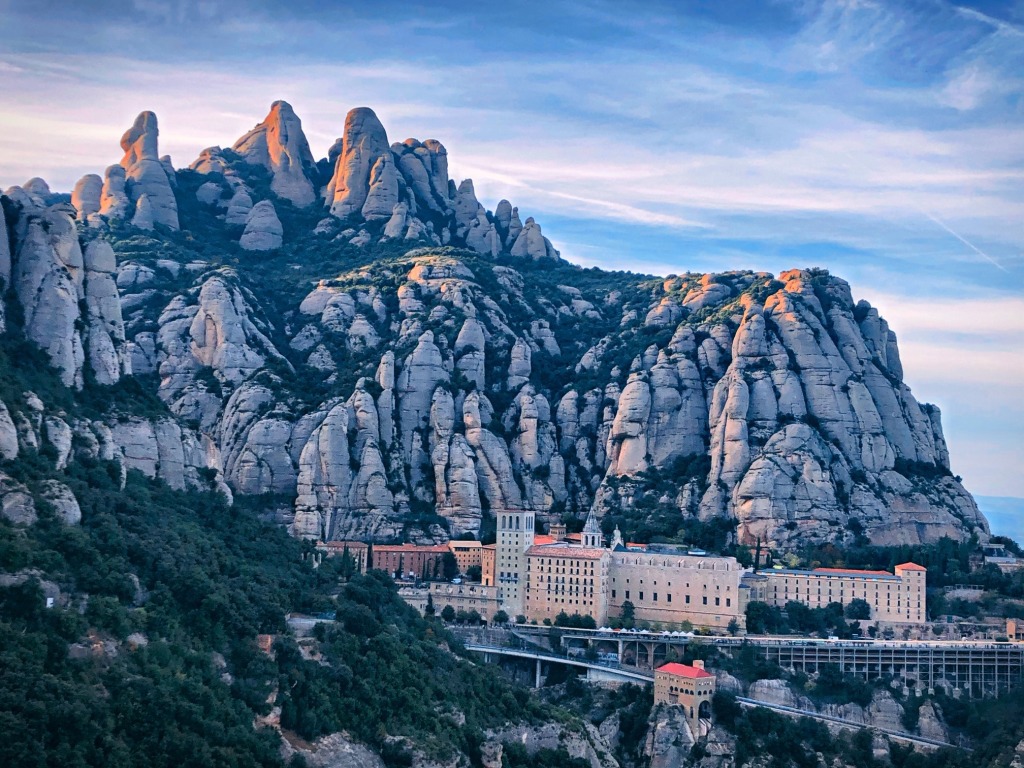
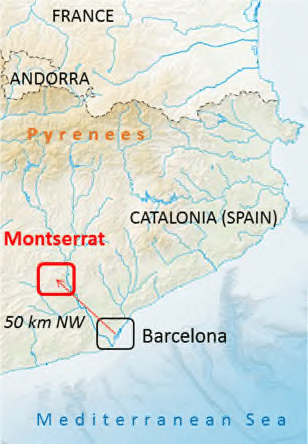
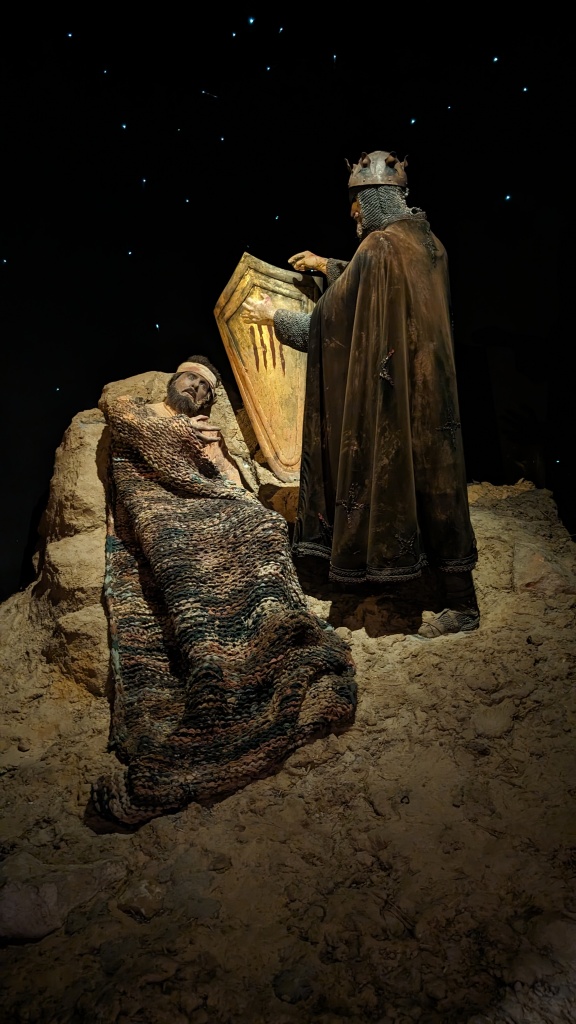
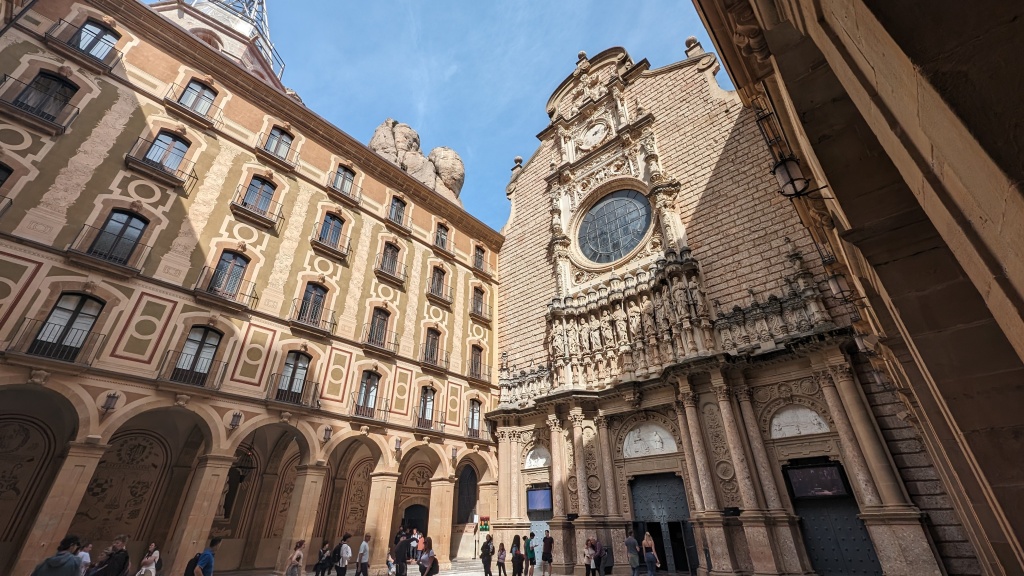
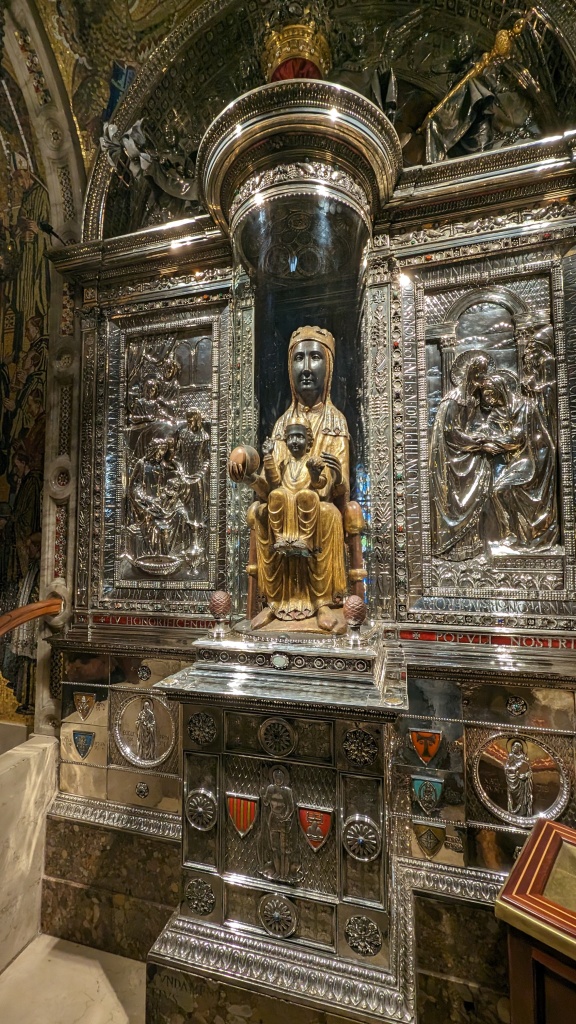
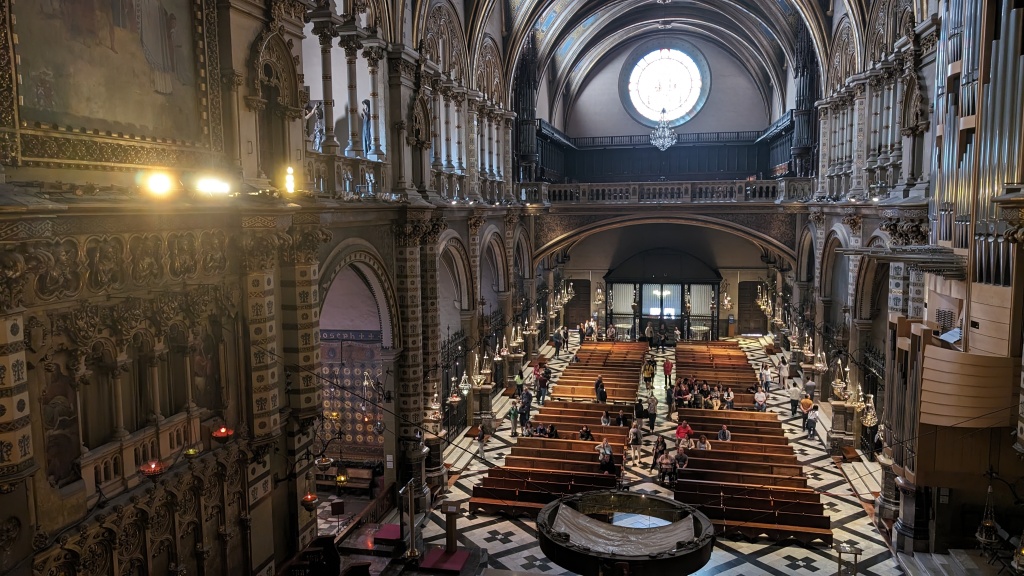
In this episode of 80 Days: An Exploration Podcast we’ll be talking about Montserrat in Catalonia, Spain, a spectacular mountain range not far from Barcelona. Montserrat was “Montserrat” literally means “serrated mountain” in Catalan, and the name accurately describes its bizarre and unique aspect with a multitude of jagged rock formations that are visible from a great distance. This spot is best known today for the Benedictine Monastery Santa Maria de Montserrat, located about 45 km northwest of Barcelona, and the the statue of the Virgin Mary within that lends its name to the monastery, which has its own unique story to tell. Montserrat has been of significance for centuries, bearing witness to Catalan and Spanish history from its lofty mount and even becoming entwined in some of the most decisive conflicts to have swept across the Iberian Peninsula since the Monastery was founded in 1025, including the Napeolonic wars and the brutal fighting pre and post the Spanish Civil War. In terms of poulation, there are less than 100 monks who make their permanent home here, but up to two million tourists flock here each year to scale the mountain and take in the history and legacy of the monastery, including quite recently, two of the co-hosts of this episode. 

Your hosts, as always, are Luke Kelly @thelukejkelly in Dublin, Ireland and Joe Byrne @anbeirneach in Dublin, Ireland, joined in this epiosde by John Killeen in Hastings, UK. Our theme music and other stings come from Thomas O’Boyle @thatthomasfella.

Some further reading material is provided below:

Music includes:

  • Virolai, the Catalan Anthemm performed by Escolania de Montserrat


Thanks to all our patrons who support the show. We really appreciate your continued backing of us. If you want to join them, more information is available at www.patreon.com/80dayspodcast

Aaland (S6.04)

Audio: Åland

In this episode of 80 Days: An Exploration Podcast we’ll be talking about Åland, an autonomous and demilitarized archipelago of Finland, which lies between Finland and Sweden, although it is closer to the latter by around 20km. Åland (which can also be spelled Aaland) is the smallest region of Finland by both area (1,580 km2 or 610 sq mi) and population (30,000), constituting around half a percent of Finland’s land area and half a percent of its population. Despite being Finnish, the only official language is Swedish and the capital city is Mariehamn. Aaland is made up of around 6,700 islands, making it one of the world’s largest archipelagos. 

Since the end of WWI, Åland has been politically neutral and entirely demilitarised, and residents are exempt from conscription to the Finnish Defence Forces.

Fasta Åland or Main Åland is the largest island in the group and accounts for more than 70 percent of the total land area and is home to about 90 percent of the archipelago’s population, as well as the capital Mariehamn. In terms of land area, Aaland is comparable to the Faroe Islands, American Samoa, Guam, Oahu (Hawaii). Out of approximately 6,500 islands, 65 are inhabited with several connected through causeways and bridges. The rest are linked by ferries and private boats. 

Åland’s original name was in the Proto-Norse language Ahvaland. Proto-Germanic ahwō is related to the Latin word for water, aqua. In Swedish, this first developed into Áland and eventually into Åland, literally ‘river land’—even though rivers are not a prominent feature of Åland’s geography. For reasons I’m sure we’ll get to, almost all the houses, and pretty much all the roads, are red. There are also roughly as many deers here as there are people.

Your hosts, as always, are Luke Kelly @thelukejkelly in Dublin, Ireland, Mark Boyle @markboyle86 in Toronto, Canada, and Joe Byrne @anbeirneach in Dublin, Ireland. Our theme music and other stings come from Thomas O’Boyle @thatthomasfella.

Flag_of_Åland
Aland-Islands-map

Some further reading material is provided below:

Music includes:

  • The recording on Svea Jannson’s “Who Can Sail Without Wind” is here on Wikipedia.
  • You can find Oolanin Sota (the Finnish Crimean war song) on YouTube.


Thanks to all our patrons who support the show. We really appreciate your continued backing of us. If you want to join them, more information is available at www.patreon.com/80dayspodcast

Minisode: Christmas Markets and Treats

Audio: Minisode – Christmas Markets & Treats

Ho ho ho! In this Christmas minisode, we’ll be talking about Christmas Markets and a few delicious festive treats, as well as where these things come from and how they’ve changed to the modern day.  

Your hosts are Luke Kelly @thelukejkelly and Joe Byrne @anbeirneach in Dublin, Ireland. Our usual co-host Mark Boyle @markboyle86 was missing for this one, but he’ll return very soon. Our theme music and other stings come from Thomas O’Boyle @thatthomasfella.

Some further reading material is provided below:

Joe & Luke visiting a Christmas Market in Dublin earlier this month


Thanks to all our patrons who support the show. We really appreciate your continued backing of us. If you want to join them, more information is available at www.patreon.com/80dayspodcast

Tsushima (S6.02)

Audio: Tsushima

In this episode of 80 Days: An Exploration Podcast, we’ll be talking about Tsushima, an island in Nagasaki Prefecture, Japan, which lies in the Tsushima Strait on the western side of Kyushu, the southernmost mainland island of Japan. Tsushima sits between Japan and South Korea, about 60 km from Iki, its closest island neighbour, 138 km from the city of Fukuoka, and 49.5 km from Busan, South Korea.

Tsushima has a total area is 708.61 km2, making up 17.3% of the area of Nagasaki Prefecture and meaning it’s a similar size to Singapore, Dominica or a bit larger than Guam. Sitting astride the Tsushima Strait between Korea and Japan, the island has long been a site of conflict, being disputed between Korea and Japan even into the modern day.  

The island famously played witness to the Battle of Tsushima in 1905, a naval engagement which took place just offshore between the Japanese and Russian Navies and resulted in a decisive victory for the Japanese, signaling the end of the Russo-Japanese War which was a major contributing factor in the buildup to the Russian Revolution. 

However, Tsushima is best-known for being at the forefront of the Mongol Invasions of Japan in 1274 and 1281, in events which are still commemorated today, and which were immortalized in the 2020 video game Ghosts of Tsushima.  

Your hosts, as always, are Luke Kelly @thelukejkelly in Dublin, Ireland, Mark Boyle @markboyle86 in Toronto, Canada, and Joe Byrne @anbeirneach in Dublin, Ireland. Our theme music and other stings come from Thomas O’Boyle @thatthomasfella.

Some further reading material is provided below:

tsushima_rizcrescini_024

Izuhara Castle Town on Tsushima


Thanks to all our patrons who support the show. We really appreciate your continued backing of us. If you want to join them, more information is available at www.patreon.com/80dayspodcast

Minisode: Christmas & The North Pole

Audio: Christmas & The North Pole

In this episode of 80 Days: An Exploration Podcast, we’re (sort of) exploring the history of the North Pole, and in particular, it’s significance to the Christmas season. We also conduct our now-traditional Christmas quiz, and give a brief update on Season 6. From all of us, have a very merry festive season, and we’ll see you in 2023.

Your hosts, as always, are Luke Kelly @thelukejkelly in Dublin, Ireland, Mark Boyle @markboyle86 in the UK, and Joe Byrne @anbeirneach in Galway, Ireland. Our theme music and other stings come from Thomas O’Boyle @thatthomasfella. 
Thanks to all our patrons who support the show. We really appreciate your continued backing of us. If you want to join them, more information is available at www.patreon.com/80dayspodcast

See you in Season 6!

Kalmykia (S5.10)

Audio: Kalmykia

In this episode of 80 Days: An Exploration Podcast, thanks to our backers on Patreon, we’ll be talking about Kalmykia, a republic and country of Russia located directly north of the North Caucasus in Eastern Europe, between Ukraine and Kazakhstan, only around 200 miles or 350km north of Georgia. The Kalmyks, of Mongol origin, migrated to the Caspian region in the 17th century from Central Asia. They were mainly nomadic cattle breeders. Kalmykiya was established in 1920 as an autonomous oblast (region); in 1936 it became a republic, which was abolished in 1944 when the Kalmyks were exiled for alleged collaboration with the Germans during WW2. 

The territory of Kalmykia is unique in that it has been the home in successive periods to many major world religions and ideologies. Prehistoric paganism and shamanism gave way to Judaism amongst some of the Khazars (who included Muslims and Christians in equal or greater numbers as well). This was succeeded by Islam with the Alans while the Mongol hordes brought Tengriism, and the later Nogais were Muslims, before their replacement by the present-day Buddhist Oirats/Kalmyks. It now stands as the only Buddhist region in Europe. 

The republic covers an area of around 76,000 square kilometres (or almost 30,000 square miles), making it a similar size to Panama, Czechia or the US state of South Carolina. With a population of about 275,000 residents Kalmykia ranks among the smallest of Russia’s federal districts in terms of population. 

The Kalmyks benefit from their relatively high levels of education and strong international connections. Overseas communities are found today in many parts of Europe and in the United States. The head of the religious establishment in Kalmykia itself was born in Philadelphia before being recognized by the Dalai Lama as a reincarnation of a Buddhist saint. 

The capital and largest city of the republic is Elista, which has gained a reputation for, of all things, international chess. And for you Star Wars fans, the Ewok language was based on Kalmyk, because George Lucas thought it sounded so odd.  

_45840472_kalmykia226 (1)
Screenshot 2022-08-10 at 21.38.02
Your hosts, as always, are Luke Kelly @thelukejkelly in Dublin, Ireland, Mark Boyle @markboyle86 in the UK, and Joe Byrne @anbeirneach in Galway, Ireland. Our theme music and other stings come from Thomas O’Boyle @thatthomasfella. 

As we mention in the episode, this finale to season 5 was voted on by our Patreon backers, and thanks as always to all of them for their support. You can sign up to Patreon to get a say in the episodes we cover in the seasons to come.

Some further reading for this episode:

An excellent documentary from DW on Kalmykia

Music used in this episode:

Thanks to all our patrons who support the show. We really appreciate your continued backing of us. If you want to join them, more information is available at www.patreon.com/80dayspodcast

See you in Season 6!

Hawaii (S5.09)

Audio: Hawaii

In this episode of 80 Days: An Exploration Podcast, we’ll be talking about Hawaii, and specifically the Big Island of Hawaii. Which is also called Hawaii.

Hawaii is the southeasternmost of the Hawaiian Islands, which make up the US state of Hawaii. The island makes up 63% of the archipelago’s landmass, but only 13% of its total population. The island is the third largest island in Polynesia, behind the two main islands of New Zealand. With a total area of around 10,000 km2 (or 4,000 square miles), Hawaii is similar in size to the islands of Puerto Rico or Cyprus, or our old friend Gambia.   

With a rich history and culture, Hawaii and its sister islands flourished as ancient societies, developing unique religions and customs, that is until the arrival of one Captain James Cook. In 1779 the famous explorer made his second and final landing here, and would not make it off the island alive. By the end of the century, the islands came under the protection of the British Crown, and missionaries soon followed, changing island life forever. The 1800s brought modern developments and the consolidation of the Kingdom of Hawaii, but ended in the annexation of the territory by the United States, a controversial episode to this day. In 1959, Hawaii becomes the 50th State, now famous for tourism, spam and pineapples. Hawaii Island, also known simply as The Big Island, is today home to around 185,000 people, and due to ongoing volcanic activity, Hawaii is the only US state that is still growing.

Hawaii_map 

Hawaii-flag

Your hosts, as always, are Luke Kelly @thelukejkelly in Dublin, Ireland, Mark Boyle @markboyle86 in the UK, and Joe Byrne @anbeirneach in Galway, Ireland. Our theme music and other stings come from Thomas O’Boyle @thatthomasfella. Thanks to Kuʻu Kauanoe one of the hosts of the Offshore Podcast from Honolulu Civil Beat, for speaking to us for this episode – you will hear clips from her interview throughout.

1402px-Distant_view_of_the_suburbs_of_Hilo,_Hawaii,_1907_(CHS-427)

The city of Hilo in 1907

Some further reading material is provided below:

  • A great website for all things Big Island is Love Big Island, and is particularly useful for tourists wishing to visit, but also helped us with plenty of history.
  • Rethinking the Native Hawaiian Past By Kanalu G. Terry Young is available on Google Books.
  • For more on the Kapu system, see storymaps.com
  • Hawaii: The Aloha State By Robin Doak has a lot more on the process of annexation, which you can find on Google Books.
  • The Eisenhower Library has more on Hawaii’s journey to statehood, which you can find here.
  • Smithsonian Magazine has an excellent article on Liliʻuokalani, the Last Queen of Hawaiʻi.
  • The Stuff You Should Know episode on the annexation is available here. Thanks, Josh and Chuck!
  • Richard B Frank’s article in TIME, headlined How Hawaii’s Japanese Population Was Spared Internment During World War II was a key source for that section of the show.
  • For more on the totally not supervillian Starfish Prime, you can check out this article in Discover Magazine.
  • Hawaii Beef also has lots of info on cattle farming on the islands.
  • Finally, the season of the Offshore Podcast on race relations in Hawaii can be found here. It’s definitely worth a listen.

green-sand-beach-hawaii-pictures
Check out that green sand!

The music used in this episode is as follows:


Thanks to all our patrons who support the show. We really appreciate your continued backing of us. If you want to join them, more information is available at www.patreon.com/80dayspodcast