Socotra (S6.08)

Audio: Socotra

In this episode of 80 Days: An Exploration Podcast we’ll be talking about Socotra, an island in the Indian Ocean, lying between the Gulf of Aden and the Arabian Sea. It lies 380 kilometres (205 nautical miles) south of the Arabian Peninsula and 240 kilometres (130 nautical miles) east of Somalia. Geographically part of Africa, it has historically been an extremely isolated island due to the monsoon winds that make it difficult to reach for large parts of the year. This isolation has resulted in unique plant and animal life, with the island harbouring many species which went extinct elsewhere tens of thousands of years ago, and It has been described as “the most alien-looking place on Earth”
Over its history, the island has seen influence from Ethiopian Christians, Greeks, Arabs, Portuguese Explorers and the British East India Company, among others, and as a result has a unique blend of cultures and languages. The island is 3,796 km2 (1,466 sq mi) in size, making it similar in land area to the US state of Rhode Island, or slightly larger than Luxembourg. Around 50,000 people today call Socotra home, with the principal city, Hadibu, boasting around a fifth of the total population. The island became a part of Yemen in 1967,  and has recently been impacted by ongoing conflict caused by the Yemeni Civil War, which began in 2014 and is ongoing as we record this. In 2008, Socotra was recognised as a UNESCO World Heritage Site for its unique flora and fauna. The islanders rub noses when they are introduced, and primarily speak Soqotri, an ancient Semitic language, which has up to a hundred words to describe a goat.

Your hosts, as always, are Luke Kelly @thelukejkelly in Dublin, Ireland, Mark Boyle @markboyle86 in Toronto, Canada, and Joe Byrne @anbeirneach in Dublin, Ireland. Our theme music and other stings come from Thomas O’Boyle @thatthomasfella.

Some further reading material is provided below:

Music relevant to Socotra includes:


Thanks to all our patrons who support the show. We really appreciate your continued backing of us. If you want to join them, more information is available at www.patreon.com/80dayspodcast
Paraguay (S5.02)

Audio: Paraguay


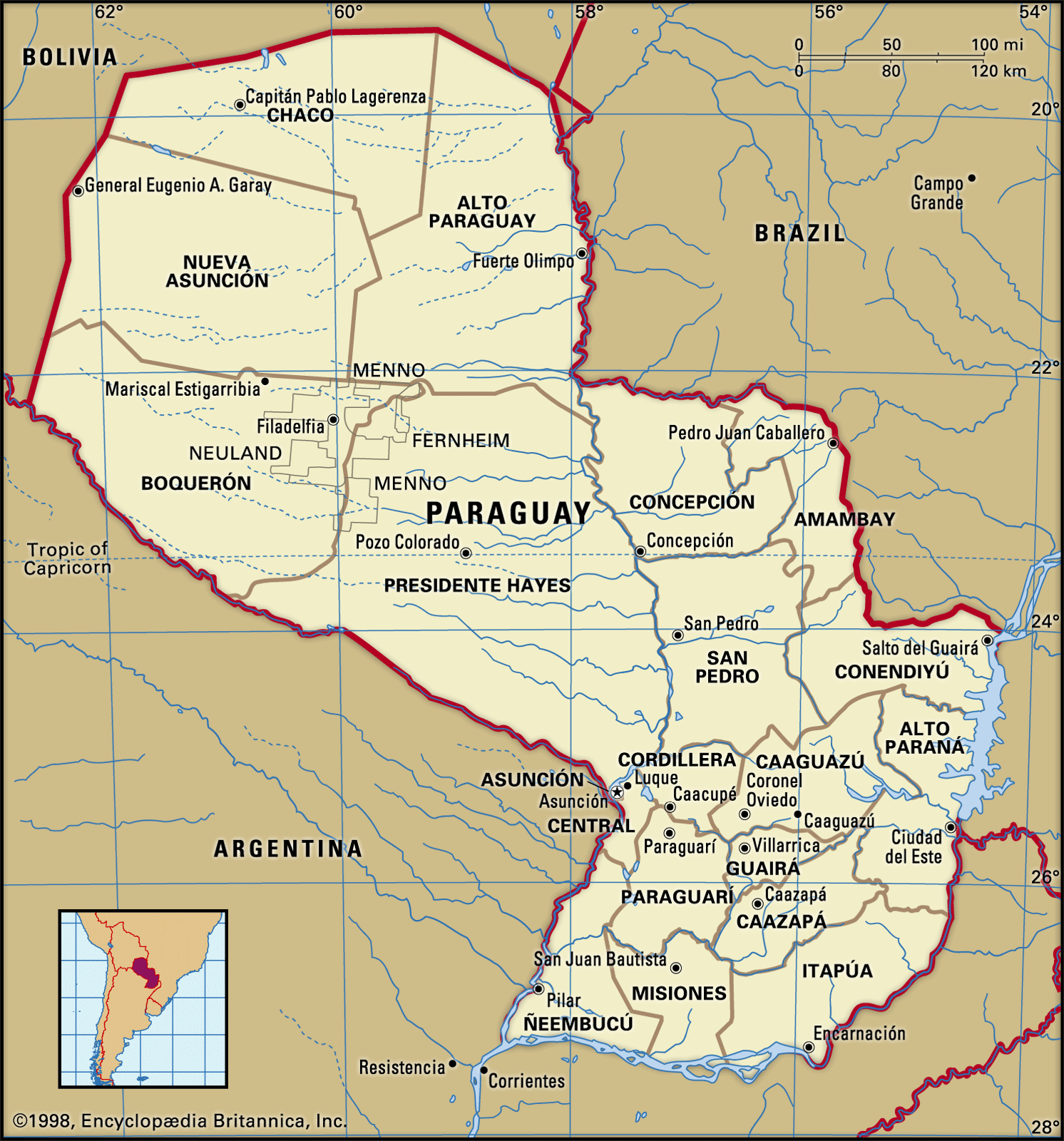
In this episode of 80 Days: An Exploration Podcast, we’ll be talking about Paraguay, a small South American nation sometimes referred to as the “heart of South America”, bordered by Argentina to the south and southwest, Brazil to the east and northeast, and Bolivia to the northwest. One of only two landlocked countries in South America, the other being Bolivia, Paraguay was home to a number of Native Indian groups, most prominently the Guarani, before being colonised by Spanish conquistadores in the early 1500s.

Paraguay-map-boundaries-cities-locator

During the 17th century, Paraguay became home to a large number of Jesuit missions, where the native Guaraní people were settled and converted to Christianity. Following independence from Spain in the early 19th century, the country was involved in a number of regional conflicts and subject to the whims of numerous dictatorial governments. This period culminated in the disastrous Paraguayan War, which began in 1864 and resulted in the country losing up to half of its prewar population and up to a third of its territory.  Since colonisation, the Guarani culture, language and traditions have remained integral to the country’s national identity, and the majority of modern day Paraguayans are mestizo, descending from a mix of settlers and Guarani. The country has around seven million inhabitants today, and has a land area of around 400,000 sq km or 150,000 sq miles, comparable in size to Norway and slightly smaller than the US state of California. Despite a history of poverty and political repression, Paraguay often ranks as the “world’s happiest place” based on global polling data.

Your hosts, as always, are Luke Kelly @thelukejkelly in Dublin, Ireland, Mark Boyle @markboyle86 in the UK, and Joe Byrne @anbeirneach in Galway, Ireland. Our theme music and other stings come from Thomas O’Boyle @thatthomasfella. 

Some further reading:

  • Do your homework if you haven’t already and check out our Uruguay episode from way back in season 2.
  • Read more on the Jasuka Venda discovery of human habitation dating to 5,000 years, displaying “footprint style rock art”
  • More on the indigenous groups, including the Payaguá (whence the name Paraguay), Guaycurú, M’bayá, Abipón, and Chiriguano.
  • Historian Adalberto Lopez has written extensively on this region. His book on the The Revolt of the Comuñeros, 1721–1735 can be found here.
  • For more on the life of the Guarani and how their traditions have persisted through to the modern day, check out this video, which Joe mentions toward the end of this episode.
  • The trailer for period film The Mission, in all its glory, can be found on YouTube.
  • The UNESCO World Heritage website has more on the Jesuit Missions of La Santísima Trinidad de Paraná and Jesús de Tavarangue.
  • The Library of Congress also has a wealth of info on Paraguay which can be found here.
  • Wikipedia has a whole article dedicated to the unique Paraguayan Flag.
  • This fascinating video shows how the Paraguayan War played out day by day using map visualisations.
  • Military Wiki also has an extensive article on Francisco Solano Lopez, who is discussed at length in this episode.
  • Historian Leslie Bethell has written a paper on the Paraguayan War which can be found here.
  • Thomas L Whigham’s book The Paraguayan War: Causes and Early Conduct, quoted in this episode, is also available in its entirety online is here.
  • Eliza Lynch has an extensive page over on Wikipedia.
  • The two 150th anniversary articles referenced on the impact of the war on Paraguay are available from The Economist and The Guardian.
  • The New York Times has an article on the 1887 Nueva Germania colony that Joe speaks about in his second section.
  • TIME has a piece on the Nazi outposts in San Bernadino that are discussed in this episode, as does OZY.
  • The US Library of Congress has a short paper on Paraguay and WWII.
  • Read more on Paraguay’s hydropower capabilities at hydropower.org.
  • José Felix Estigarribia, who Mark discusses in this episode, is profiled here at Britannica.
  • The graphic below gives an interesting indication of the plurality of languages spoken in Paraguay in the modern day.
  • For more on food, check out Culture Trip for 6 Traditional Foods You Have to Try in Paraguay

Some music by composers from in and around this region include:

  • Sanapana music from the Gran Chaco tribe, taken from this video.
  • The polka song, written in Guarani by Emiliano Fernandez about the Chaco War and performed by Romón Vargas Colman, can be found here.
  • We also include some Paraguayan Harp in this episode, which you can find more of here.
  • For a selection of music from Augustin Barrios, one of Paraguay’s most famous musicians, click here.