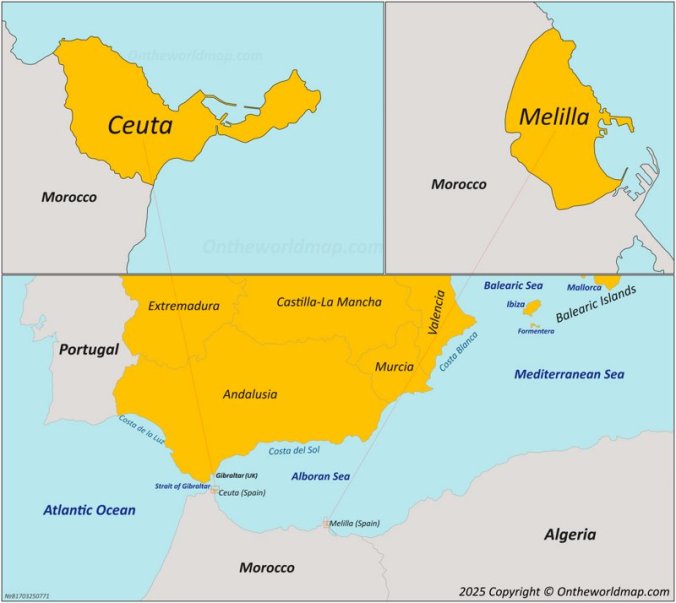
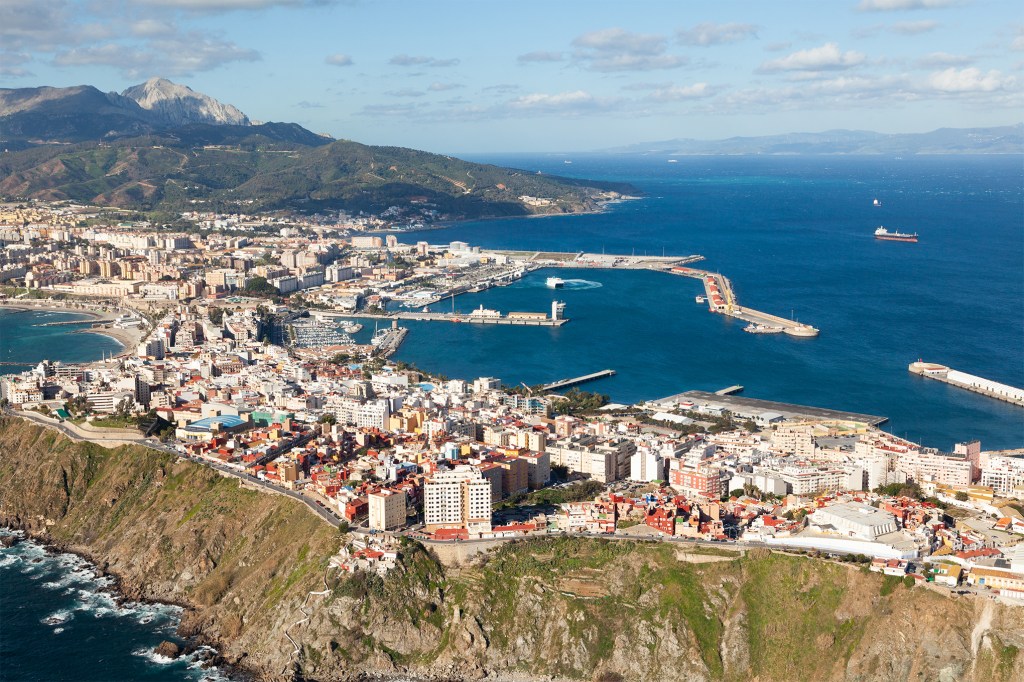
In this episode of 80 Days: An Exploration Podcast we’ll be talking about the autonomous city of Ceuta — Spanish exclave, military post, and free port on the coast of Morocco, at the Mediterranean entrance to the Strait of Gibraltar. Ceuta, Melilla (also an exclave), and other tiny islets along the coast of North Africa constitute the territories of Spanish North Africa. The city is on a narrow isthmus that connects Mount Hacho (also held by Spain) to the mainland. Mount Hacho has been identified as possibly the southern Pillar of Heracles, of the ancient Mediterranean world. Ceuta was controlled by the Muslim Umayyad Dynasty up to 1415, and then changed hands a number of times over the 15th and 16th Centuries. It played an important role in the Spanish Civil War, and gained its modern autonomous status in 1995. Ceuta’s land area is only about 18.5 square kilometres or 7 square miles, making it among the smallest places we’ve ever talked about, and has a population of around 80,000, similar to Andorra, the Isle of Man or the US Virgin Islands.
The climate here is warm but moderated by the straits, with mean annual temperatures of 18 °C (65 °F) with average highs of 21 °C (70 °F) and lows of 15 °C (60 °F). The currency is the Euro, and the language is Spanish, with a strong Arabic presence.
Ceuta and Melilla are the only piece of EU territory on mainland Africa – a political and legal reality that has never been recognised by Morocco, which claims both territories to this day.
Fun Fact – Western Sahara was a previously-Patreon-backed finale episode. You guys just have a real hankering for contentious North African territories, don’t you?
As we mention in the episode, this (somewhat delayed) finale to season 6 was voted on by our Patreon backers, and thanks as always to all of them for their support. You can sign up to Patreon to get a say in the episodes we cover in the seasons to come.
Your hosts, as always, are Luke Kelly @thelukejkelly in Wexford, Ireland, Mark Boyle @markboyle86 in Toronto, Canada, and Joe Byrne @anbeirneach in Dublin, Ireland. Our theme music and other stings come from Thomas O’Boyle @thatthomasfella.

Some further reading material is provided below:
- This BBC Explainer on the status of Ceuta and Melilla is a good starting point for beginners. The BBC also has a useful factsheet.
- This CNN feature headlined “Inside the tiny corner of Spain that lies in the middle of North Africa” is another useful primer.
- History blog “A Small Part of History” has a lengthy post about the conquest of Ceuta by Portugal.
- For a more visceral look at the city, this video travel guide of Ceuta from Travel Obscurer is worth checking out.
- One of the many books we referenced in this episode was Europe or Africa? : a contemporary study of the Spanish North African enclaves of Ceuta and Melila by Peter Gold. It’s available on Archive.org.
- We also spoke about Count Julian, whose Wikipedia page is well worth perusing.
- Mark lent on A.R. Disney’s A History of Portugal and the Portuguese Empire – From Beginnings to 1807 for his section. You can find an excerpt here.
- Another useful read was The Spanish Exclaves in Morocco by Robert Rézette, which is available on Google Books.
- Anyone for a Wikipedia list of “People with the most children“? If you’ve heard Joe’s section, you’ll know why.
- For more on Lieutenant John Fraser and his trusty leg bone, see the National Army Museum.
- WebHispania has a fascinating blog post by Antonio M. Carrasco headlined The Ceuta border: a constant source of misunderstanding and conflict.
- The UK’s National Maritime Museum has a whole page dedicated to Cueta in the Napoleonic Wars.
- The UNHCR report on Anti-Muslim Hatred and Discrimination in Ceuta we mentioned is available here.
- The substantial page on Wikipedia dedicated to the border fence is here. More can be found in World of Walls: The Structure, Roles and Effectiveness of Separation Barriers by Said Saddiki which is available online here.
- On Franco and the Spanish Civil War, worth a read is The Crescent and the Dagger: Representations of the Moorish Other during the Spanish Civil War by Elisabeth Bolorinos Allard, available here.
Some of the music used in the episode includes:
- The anthem of Ceuta, which is featured in the final music break
- Some processional marches and sacred music from the General Command of Ceuta
- An example of traditional Berber Muslim music
Thanks to all our patrons who support the show. We really appreciate your continued backing of us. If you want to join them, more information is available at www.patreon.com/80dayspodcast
 80 Days