Gabon (S5.03)

Audio: Gabon

In this episode of 80 Days: An Exploration Podcast, we’ll be talking about Gabon, officially the Gabonese Republic, an equatorial country on the west coast of Africa. Originally inhabited by Bantu tribes, the area we now know as Gabon was first explored by Europeans in the 15th Century. Local inhabitants began to sell slaves to Europeans in the 18th and 19th centuries, which established the region as a hub for the slave trade. In 1910, Gabon became one of the four territories of French Equatorial Africa, and fifty years later became fully independent. Since then, the politics of the country has been dominated by Omar Bongo, Gabon’s second president, and his son Ali Bongo, who succeeded him in 2009.
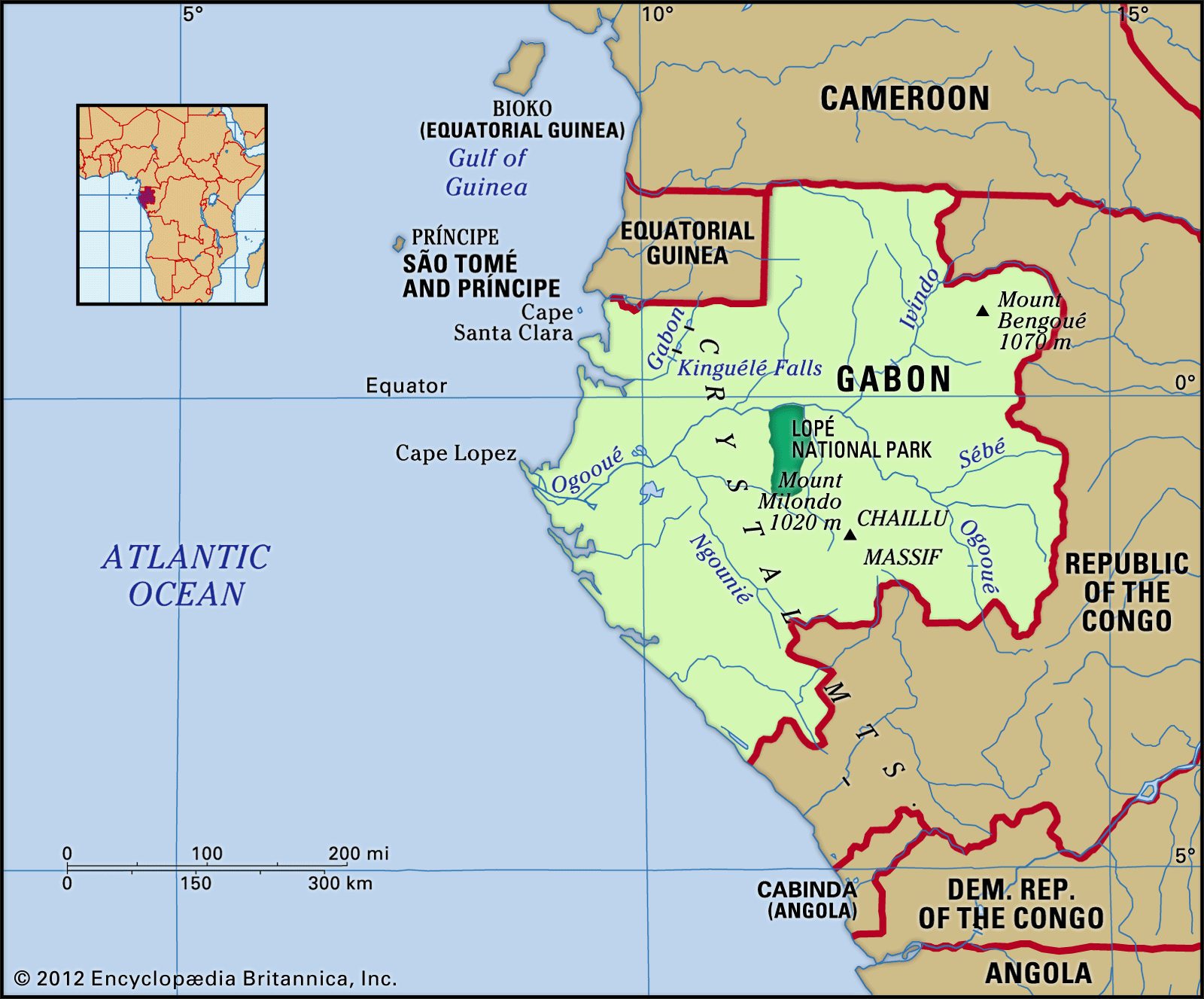
Gabon-map-features-locator

Gabon has a total land area of around 257,000 square km or just under 100,000 square miles, making it around the same size as the UK, New Zealand or the US state of Oregon. Gabon is bordered by Equatorial Guinea to the northwest, Cameroon to the north, the Republic of the Congo on the east and south. Gabon is home to just over 2.1 million people, with the vast majority of those being in Libreville, the largest city and capital, lying on the Komo River, near the Gulf of Guinea. The official language is French, although many Gabonese people speak various mother tongues according to their ethnic group, of which there are over 40.

Gabon is one of the most prosperous countries on the continent, with the fifth highest GDP per capita in all of Africa, while almost 85% of Gabon is covered by rainforests, 11% of which has been dedicated for national parks.

Your hosts, as always, are Luke Kelly @thelukejkelly in Dublin, Ireland, Mark Boyle @markboyle86 in the UK, and Joe Byrne @anbeirneach in Galway, Ireland. Our theme music and other stings come from Thomas O’Boyle @thatthomasfella. 

  • Some great examples of ancient ancestral Gabonese art can be found here.
  • For more on early history and archaeology, see iExplore.
  • You can watch a short documentary on the Punu-Lumbo mask at smarthistory.
  • For more on the life of the Dread Pirate Roberts, see here.
  • Liz Alden Wily has written an entire book on land rights in Gabon, which you can read in full online.
  • Christopher Chamberlain’s paper ‘The Migration of the Fang into Central Gabon during the Nineteenth Century: A New Interpretation’ can be found at JSTOR.
  • Gabon : beyond the colonial legacy by James Franklin Barnes can be read for free on archive.org.
  • For some more modern history (1960s onwards), see this page at the University of Central Arkansas.

Some music related to Gabon:

Thanks to all our patrons who support the show. We really appreciate your continued backing of us. If you want to join them, more information is available at www.patreon.com/80dayspodcast

Suriname (S3.07)

S03E07 Suriname Audio

In this episode of season 3 of 80 Days: an exploration podcast, we’ll be talking about the Republic of Suriname, previously known as Dutch Guiana. Located on the northern coast of South America, this roughly square shaped nation borders French Guiana to the east, Guyana to the West and Brazil to the South. Modern Suriname is both one of the smallest and most ethnically diverse countries in South America, with up to 9 recognised languages and many different ethnic groups.

At just under 165,000 square kilometers (or 64,000 square miles), Suriname is roughly the size of the US state of Washington, or Tunisia. The country’s population is around 560,000, most of whom live in the capital city of Paramaribo, near the mouth of the river Suriname. The climate here is hot and humid year-round, as the country lies just a few degrees north of the equator. As a result, its southern portion is dominated by lush, dense rainforest.   

Originally established as a British colony, Suriname was eventually traded to the Dutch in 1667 for a little island in on the east coast of North America, then known as New Amsterdam. Since gaining its independence in 1975, Suriname has maintained close ties to The Netherlands, and is today the only sovereign nation outside Europe where Dutch is spoken by a majority of the population.

Your hosts, as always, are Luke Kelly @thelukejkelly in Hong Kong, Mark Boyle @markboyle86 in the UK, and Joe Byrne @anbeirneach in Switzerland . (Theme music by Thomas O’Boyle @thatthomasfella)


Above is the current flag, the location of Suriname in South America, and the terrible old flag with five stars on a white background. Ethnic/linguistic diversity also needs to be mentioned up top. In Suriname, there are no fewer than twenty languages spoken. Most Surinamese are multilingual. In terms of numbers of speakers are the main languages in Suriname, successively the Dutch language, Sranan Tongo (Surinamese Creole), Sarnami (Surinamese Hindi), Javanese, and different Maroon languages (especially Saramaccan and Ndyuka) and Carriban languages. In recent years, English is being spoken more and more by the majority of the younger populace. 

Here are a few things you may want to read/watch more about:

Some nice Surinamese music we found:

A massive thanks to all of our patrons on Patreon who are supporting season 3. If you’d like to join them and see what rewards are available for supporters, and get a peek behind the curtain check out www.patreon.com/80dayspodcast. We really appreciate the support and input!

Saint Helena (S3.04)

S03E04 Saint Helena Audio

In this episode of season 3 of 80 Days: an exploration podcast, we’ll be talking about Saint Helena, a volcanic tropical island in the South Atlantic Ocean, and one of the most isolated points of land in the world. Saint Helena is more than 2,000 kilometres (1,200 mi) from its nearest mainland neighbour. The nearest port is Namibe in Angola. It was uninhabited up until its discovery by the Portuguese in 1502, and was later taken over by the British. Used for much of its life as an island of exile, its most famous inhabitant was Napoleon Bonaparte, who was exiled there after his defeat at Waterloo. The island today has a population of just over 4500, and is roughly the size of Staten Island in New York or San Marino, at just 121 square kilometeres, or 47 square miles, and its climate is generally mild.

The island is situated in the Western Hemisphere and despite having the same longitude as Cornwall in the United Kingdom, it is classified as being in West Africa by the United Nations.

Its inhabitants, known locally as “Saints”, are the descendants of sailors, settlers and slaves, and are said to be fiercely loyal to the British monarchy. The island’s economy is dependent on British grants and remittances, and up until recently its only link to the outside world was by a Royal Mail Ship, the St Helena, which made a five-day journey from Cape Town in South Africa, every three weeks.

Your hosts, as always, are Luke Kelly @thelukejkelly in Hong Kong, Mark Boyle @markboyle86 in the UK, and Joe Byrne @anbeirneach in Switzerland . (Theme music by Thomas O’Boyle @thatthomasfella)

Flag of Saint Helena  Global position of Saint Helena, with respect to the UK

Here are a few things you may want to read/watch more about:

Music you heard was from the following sources:

Thanks to Fran Hobbs for his insightful interview about life on the island. A massive thanks to all of our patrons on Patreon who are supporting season 3. If you’d like to join them and see what rewards are available for supporters, and get a peek behind the curtain check out www.patreon.com/80dayspodcast. We really appreciate the support and input!