Ceuta (S6.10)

Audio: Ceuta

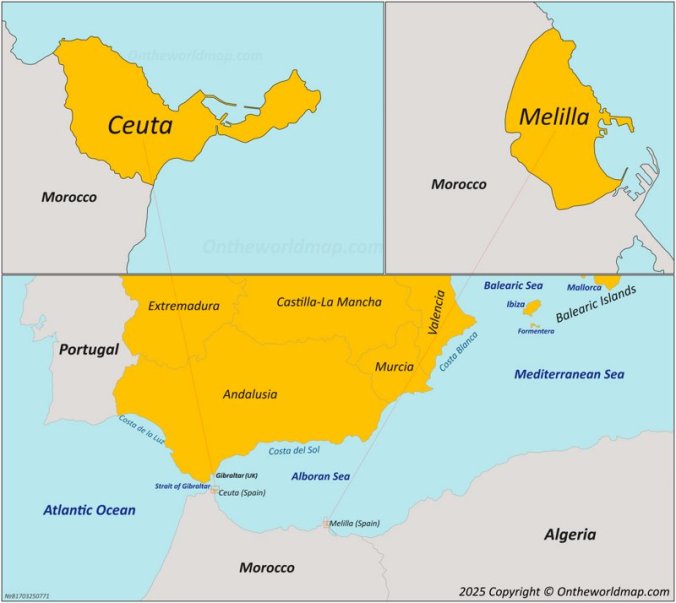
In this episode of 80 Days: An Exploration Podcast we’ll be talking about the autonomous city of Ceuta — Spanish exclave, military post, and free port on the coast of Morocco, at the Mediterranean entrance to the Strait of Gibraltar. Ceuta, Melilla (also an exclave), and other tiny islets along the coast of North Africa constitute the territories of Spanish North Africa. The city is on a narrow isthmus that connects Mount Hacho (also held by Spain) to the mainland. Mount Hacho has been identified as possibly the southern Pillar of Heracles, of the ancient Mediterranean world. Ceuta was controlled by the Muslim Umayyad Dynasty up to 1415, and then changed hands a number of times over the 15th and 16th Centuries. It played an important role in the Spanish Civil War, and gained its modern autonomous status in 1995. Ceuta’s land area is only about 18.5 square kilometres or 7 square miles, making it among the smallest places we’ve ever talked about, and has a population of around 80,000, similar to  Andorra, the Isle of Man or the US Virgin Islands. 

The climate here is warm but moderated by the straits, with mean annual temperatures of 18 °C (65 °F) with average highs of 21 °C (70 °F) and lows of 15 °C (60 °F). The currency is the Euro, and the language is Spanish, with a strong Arabic presence. 

Ceuta and Melilla are the only piece of EU territory on mainland Africa – a political and legal reality that has never been recognised by Morocco, which claims both territories to this day. 

Fun Fact – Western Sahara was a previously-Patreon-backed finale episode. You guys just have a real hankering for contentious North African territories, don’t you?

As we mention in the episode, this (somewhat delayed) finale to season 6 was voted on by our Patreon backers, and thanks as always to all of them for their support. You can sign up to Patreon to get a say in the episodes we cover in the seasons to come.

Your hosts, as always, are Luke Kelly @thelukejkelly in Wexford, Ireland, Mark Boyle @markboyle86 in Toronto, Canada, and Joe Byrne @anbeirneach in Dublin, Ireland. Our theme music and other stings come from Thomas O’Boyle @thatthomasfella.

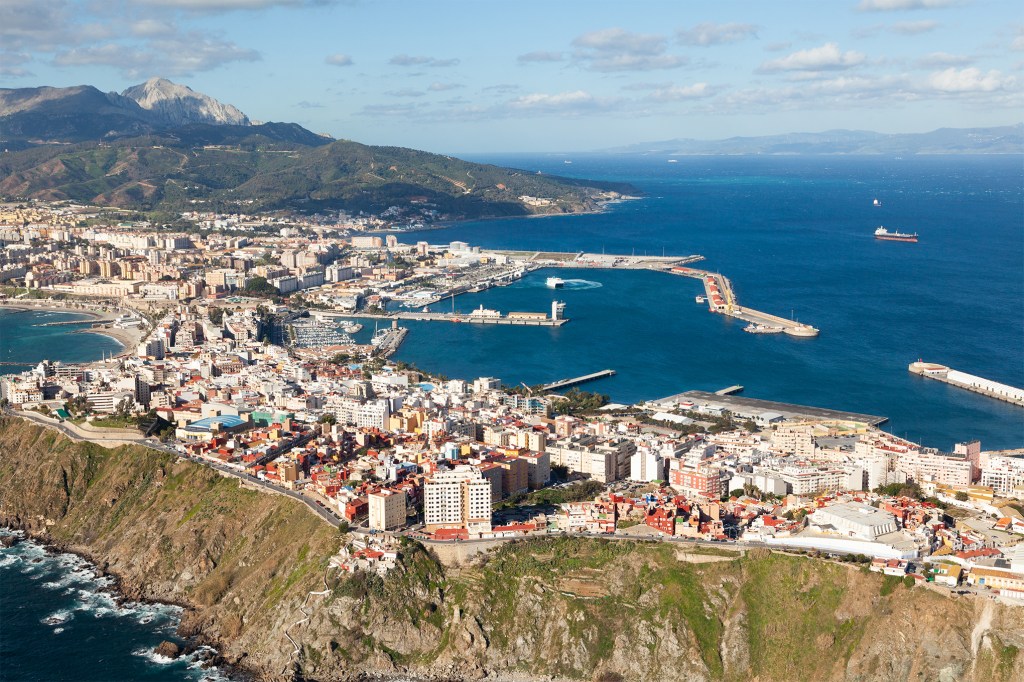
Ceuta with Mount hacho visible in the background

Some further reading material is provided below:

  • This BBC Explainer on the status of Ceuta and Melilla is a good starting point for beginners. The BBC also has a useful factsheet.
  • This CNN feature headlined “Inside the tiny corner of Spain that lies in the middle of North Africa” is another useful primer.
  • History blog “A Small Part of History” has a lengthy post about the conquest of Ceuta by Portugal.
  • For a more visceral look at the city, this video travel guide of Ceuta from Travel Obscurer is worth checking out.
  • One of the many books we referenced in this episode was Europe or Africa? : a contemporary study of the Spanish North African enclaves of Ceuta and Melila by Peter Gold. It’s available on Archive.org.
  • We also spoke about Count Julian, whose Wikipedia page is well worth perusing.
  • Mark lent on A.R. Disney’s A History of Portugal and the Portuguese Empire – From Beginnings to 1807 for his section. You can find an excerpt here.
  • Another useful read was The Spanish Exclaves in Morocco by Robert Rézette, which is available on Google Books.
  • Anyone for a Wikipedia list of “People with the most children“? If you’ve heard Joe’s section, you’ll know why.
  • For more on Lieutenant John Fraser and his trusty leg bone, see the National Army Museum.
  • WebHispania has a fascinating blog post by Antonio M. Carrasco headlined The Ceuta border: a constant source of misunderstanding and conflict.
  • The UK’s National Maritime Museum has a whole page dedicated to Cueta in the Napoleonic Wars.
  • The UNHCR report on Anti-Muslim Hatred and Discrimination in Ceuta we mentioned is available here.
  • The substantial page on Wikipedia dedicated to the border fence is here. More can be found in World of Walls: The Structure, Roles and Effectiveness of Separation Barriers by Said Saddiki which is available online here.
  • On Franco and the Spanish Civil War, worth a read is The Crescent and the Dagger: Representations of the Moorish Other during the Spanish Civil War by Elisabeth Bolorinos Allard, available here.

Some of the music used in the episode includes:


Thanks to all our patrons who support the show. We really appreciate your continued backing of us. If you want to join them, more information is available at www.patreon.com/80dayspodcast

Kalmykia (S5.10)

Audio: Kalmykia

In this episode of 80 Days: An Exploration Podcast, thanks to our backers on Patreon, we’ll be talking about Kalmykia, a republic and country of Russia located directly north of the North Caucasus in Eastern Europe, between Ukraine and Kazakhstan, only around 200 miles or 350km north of Georgia. The Kalmyks, of Mongol origin, migrated to the Caspian region in the 17th century from Central Asia. They were mainly nomadic cattle breeders. Kalmykiya was established in 1920 as an autonomous oblast (region); in 1936 it became a republic, which was abolished in 1944 when the Kalmyks were exiled for alleged collaboration with the Germans during WW2. 

The territory of Kalmykia is unique in that it has been the home in successive periods to many major world religions and ideologies. Prehistoric paganism and shamanism gave way to Judaism amongst some of the Khazars (who included Muslims and Christians in equal or greater numbers as well). This was succeeded by Islam with the Alans while the Mongol hordes brought Tengriism, and the later Nogais were Muslims, before their replacement by the present-day Buddhist Oirats/Kalmyks. It now stands as the only Buddhist region in Europe. 

The republic covers an area of around 76,000 square kilometres (or almost 30,000 square miles), making it a similar size to Panama, Czechia or the US state of South Carolina. With a population of about 275,000 residents Kalmykia ranks among the smallest of Russia’s federal districts in terms of population. 

The Kalmyks benefit from their relatively high levels of education and strong international connections. Overseas communities are found today in many parts of Europe and in the United States. The head of the religious establishment in Kalmykia itself was born in Philadelphia before being recognized by the Dalai Lama as a reincarnation of a Buddhist saint. 

The capital and largest city of the republic is Elista, which has gained a reputation for, of all things, international chess. And for you Star Wars fans, the Ewok language was based on Kalmyk, because George Lucas thought it sounded so odd.  

_45840472_kalmykia226 (1)
Screenshot 2022-08-10 at 21.38.02
Your hosts, as always, are Luke Kelly @thelukejkelly in Dublin, Ireland, Mark Boyle @markboyle86 in the UK, and Joe Byrne @anbeirneach in Galway, Ireland. Our theme music and other stings come from Thomas O’Boyle @thatthomasfella. 
As we mention in the episode, this finale to season 5 was voted on by our Patreon backers, and thanks as always to all of them for their support. You can sign up to Patreon to get a say in the episodes we cover in the seasons to come.

Some further reading for this episode:

An excellent documentary from DW on Kalmykia

Music used in this episode:

Thanks to all our patrons who support the show. We really appreciate your continued backing of us. If you want to join them, more information is available at www.patreon.com/80dayspodcast

See you in Season 6!

Nauru (S1.02)

Audio: S1E02 Nauru

In this week’s episode of 80 Days, we are talking about Nauru, a small isolated island nation in the middle of the Pacific, only 60 km from the equator and about 3,000 km from Australia, the country it is largely a dependent of. It’s a rags-to-riches-and-back-to-rags tale of an island paradise, once called Pleasant Island, its disastrous encounters with colonialism and brutal treatment in World War 2. The discovery of rich phosphate deposits led to it briefly being the wealthiest nation per capita for a time, but strip-mining and poor administration left the country where it is today – always in the news for the wrong reasons. Your hosts are Luke Kelly @thelukejkelly, Mark Boyle @markboyle86 and Joe Byrne @anbeirneach, in Hong Kong, the UK and Ireland, respectively. (Theme music by Thomas O’Boyle)

Note: We had previously said that we would broadcast our episode on Panama this week, but once again Nauru was in the news, after the release of the “Nauru files” giving details of the scale of human rights abuses in the migrant detention centres the island hosts on behalf of the Australian government. We thought that this episode would give a good background on a country you might be reading a lot about in the next few weeks. This episode was recorded before the files were released, but we do discuss the issues that were highlighted in those reports.

Some things you might want to read/listen more about:

  • Early Nauruan practice of aquaculture – i.e. catching the fries of milkfish/ibiya in the surf and raising them to adulthood in brackish pools inland. This article (Spennemann, 2002) also describes the early history of Nauru and its first encounter with European whaler John Fearn
  • The 10-year long Nauruan Tribal War is summarised in an article on Military History Now – it resulted in the death of about 500 people, nearly a third of the island’s population
  • Nauru: A Cautionary Tale, an essay by Vlad Sokhin in World Policy Journal discusses the squandering of the phosphate resources of the island and also features some great photos from the smallest republic in the world
  • S. E. Morrison’s book History of United States Naval Operations in World War II: Aleutians, Gilberts and Marshalls, June 1942 – April 1944 (Univeristy of Illinois Press, 2001) describes the operations in and around Nauru and features the following comments on the then-occupied island:

    But, the more Nauru was studied, the less anyone liked the idea of assaulting it. For Nauru is a solid island with no harbor or lagoon, shaped like a hat with a narrow brim of coastal plain where the enemy had built his airfield, and a crown where he had mounted coast defense artillery. The hilly interior was full of holes and caves where phosphate rock had been excavated – just the sort of terrain that the Japanese liked for defensive operations

  • The Japanese occupation of Nauru and deportation of the native people to Truk Island is described on Wikipedia
  • Radio show This American Life did an episode, including stories from Nauru a few years ago: “The Middle of Nowhere“, emphasising its role in money laundering and how it keeps appearing as a footnote in major world events
  • Australian Radio National’s Earshot has discussed the country’s “bizarre” story
  • Fertiliser island scents musical success: First Night: Leonardo” by David Lister in The Independent describes the opening night of Leonardo the Musical: A Portrait of Love, co-written by Duke Minks
  • Paradise Well and Truly Lost” in The Economist deals with all of Nauru’s problems and how it all went wrong, including how it can be considered a test case for understanding widespread diabetes
  • The music from the break can be found on YouTube

On a slightly lighter note… We are very fond of the names of people from Nauru, such as inaugural President Hammer deRoburt, Duke Minks (the musical guy), Kelly Emiu (chief secretary to the government who was involved in the musical happening) and current President Baron Waqa. And finally, video evidence that Naruans are quite good at powerlifting:

Next week’s episode will be more cheerful, we promise.