Ceuta (S6.10)

Audio: Ceuta

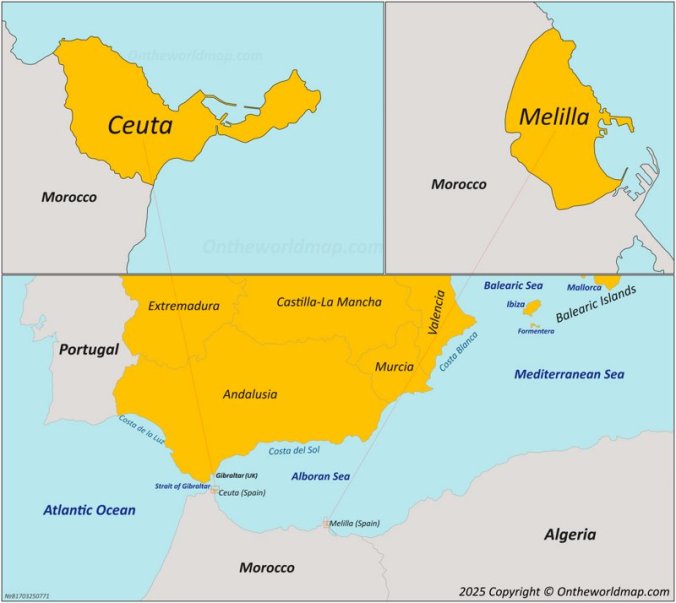
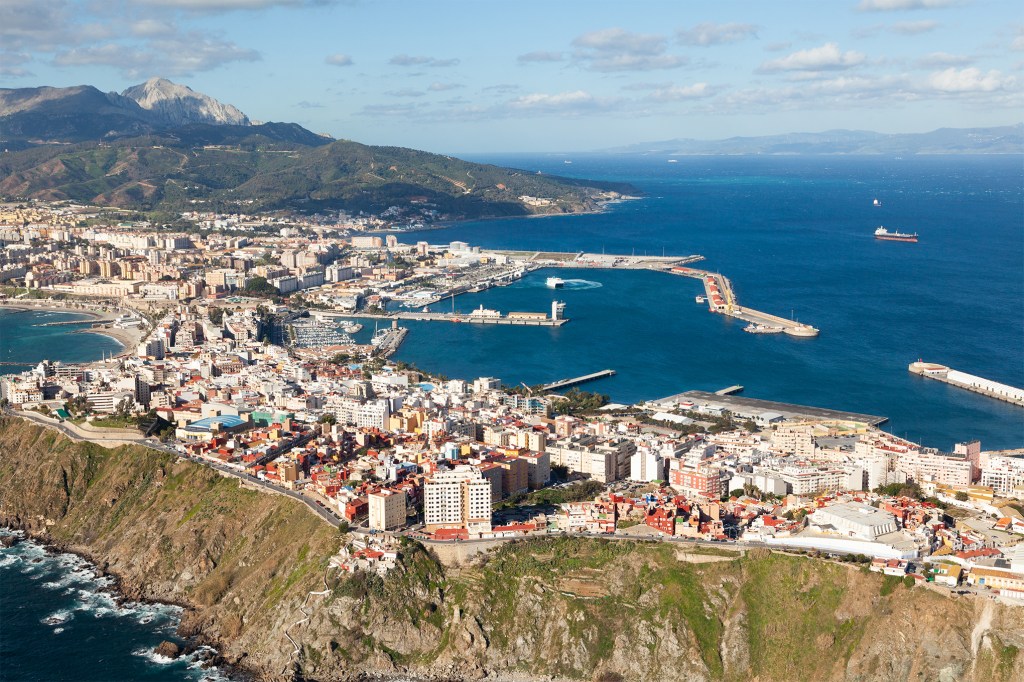
In this episode of 80 Days: An Exploration Podcast we’ll be talking about the autonomous city of Ceuta — Spanish exclave, military post, and free port on the coast of Morocco, at the Mediterranean entrance to the Strait of Gibraltar. Ceuta, Melilla (also an exclave), and other tiny islets along the coast of North Africa constitute the territories of Spanish North Africa. The city is on a narrow isthmus that connects Mount Hacho (also held by Spain) to the mainland. Mount Hacho has been identified as possibly the southern Pillar of Heracles, of the ancient Mediterranean world. Ceuta was controlled by the Muslim Umayyad Dynasty up to 1415, and then changed hands a number of times over the 15th and 16th Centuries. It played an important role in the Spanish Civil War, and gained its modern autonomous status in 1995. Ceuta’s land area is only about 18.5 square kilometres or 7 square miles, making it among the smallest places we’ve ever talked about, and has a population of around 80,000, similar to  Andorra, the Isle of Man or the US Virgin Islands. 

The climate here is warm but moderated by the straits, with mean annual temperatures of 18 °C (65 °F) with average highs of 21 °C (70 °F) and lows of 15 °C (60 °F). The currency is the Euro, and the language is Spanish, with a strong Arabic presence. 

Ceuta and Melilla are the only piece of EU territory on mainland Africa – a political and legal reality that has never been recognised by Morocco, which claims both territories to this day. 

Fun Fact – Western Sahara was a previously-Patreon-backed finale episode. You guys just have a real hankering for contentious North African territories, don’t you?

As we mention in the episode, this (somewhat delayed) finale to season 6 was voted on by our Patreon backers, and thanks as always to all of them for their support. You can sign up to Patreon to get a say in the episodes we cover in the seasons to come.

Your hosts, as always, are Luke Kelly @thelukejkelly in Wexford, Ireland, Mark Boyle @markboyle86 in Toronto, Canada, and Joe Byrne @anbeirneach in Dublin, Ireland. Our theme music and other stings come from Thomas O’Boyle @thatthomasfella.

Ceuta with Mount hacho visible in the background

Some further reading material is provided below:

  • This BBC Explainer on the status of Ceuta and Melilla is a good starting point for beginners. The BBC also has a useful factsheet.
  • This CNN feature headlined “Inside the tiny corner of Spain that lies in the middle of North Africa” is another useful primer.
  • History blog “A Small Part of History” has a lengthy post about the conquest of Ceuta by Portugal.
  • For a more visceral look at the city, this video travel guide of Ceuta from Travel Obscurer is worth checking out.
  • One of the many books we referenced in this episode was Europe or Africa? : a contemporary study of the Spanish North African enclaves of Ceuta and Melila by Peter Gold. It’s available on Archive.org.
  • We also spoke about Count Julian, whose Wikipedia page is well worth perusing.
  • Mark lent on A.R. Disney’s A History of Portugal and the Portuguese Empire – From Beginnings to 1807 for his section. You can find an excerpt here.
  • Another useful read was The Spanish Exclaves in Morocco by Robert Rézette, which is available on Google Books.
  • Anyone for a Wikipedia list of “People with the most children“? If you’ve heard Joe’s section, you’ll know why.
  • For more on Lieutenant John Fraser and his trusty leg bone, see the National Army Museum.
  • WebHispania has a fascinating blog post by Antonio M. Carrasco headlined The Ceuta border: a constant source of misunderstanding and conflict.
  • The UK’s National Maritime Museum has a whole page dedicated to Cueta in the Napoleonic Wars.
  • The UNHCR report on Anti-Muslim Hatred and Discrimination in Ceuta we mentioned is available here.
  • The substantial page on Wikipedia dedicated to the border fence is here. More can be found in World of Walls: The Structure, Roles and Effectiveness of Separation Barriers by Said Saddiki which is available online here.
  • On Franco and the Spanish Civil War, worth a read is The Crescent and the Dagger: Representations of the Moorish Other during the Spanish Civil War by Elisabeth Bolorinos Allard, available here.

Some of the music used in the episode includes:


Thanks to all our patrons who support the show. We really appreciate your continued backing of us. If you want to join them, more information is available at www.patreon.com/80dayspodcast

Socotra (S6.08)

Audio: Socotra

In this episode of 80 Days: An Exploration Podcast we’ll be talking about Socotra, an island in the Indian Ocean, lying between the Gulf of Aden and the Arabian Sea. It lies 380 kilometres (205 nautical miles) south of the Arabian Peninsula and 240 kilometres (130 nautical miles) east of Somalia. Geographically part of Africa, it has historically been an extremely isolated island due to the monsoon winds that make it difficult to reach for large parts of the year. This isolation has resulted in unique plant and animal life, with the island harbouring many species which went extinct elsewhere tens of thousands of years ago, and It has been described as “the most alien-looking place on Earth”
Over its history, the island has seen influence from Ethiopian Christians, Greeks, Arabs, Portuguese Explorers and the British East India Company, among others, and as a result has a unique blend of cultures and languages. The island is 3,796 km2 (1,466 sq mi) in size, making it similar in land area to the US state of Rhode Island, or slightly larger than Luxembourg. Around 50,000 people today call Socotra home, with the principal city, Hadibu, boasting around a fifth of the total population. The island became a part of Yemen in 1967,  and has recently been impacted by ongoing conflict caused by the Yemeni Civil War, which began in 2014 and is ongoing as we record this. In 2008, Socotra was recognised as a UNESCO World Heritage Site for its unique flora and fauna. The islanders rub noses when they are introduced, and primarily speak Soqotri, an ancient Semitic language, which has up to a hundred words to describe a goat.

Your hosts, as always, are Luke Kelly @thelukejkelly in Dublin, Ireland, Mark Boyle @markboyle86 in Toronto, Canada, and Joe Byrne @anbeirneach in Dublin, Ireland. Our theme music and other stings come from Thomas O’Boyle @thatthomasfella.
Some further reading material is provided below:

Music relevant to Socotra includes:


Thanks to all our patrons who support the show. We really appreciate your continued backing of us. If you want to join them, more information is available at www.patreon.com/80dayspodcast

Aaland (S6.04)

Audio: Åland

In this episode of 80 Days: An Exploration Podcast we’ll be talking about Åland, an autonomous and demilitarized archipelago of Finland, which lies between Finland and Sweden, although it is closer to the latter by around 20km. Åland (which can also be spelled Aaland) is the smallest region of Finland by both area (1,580 km2 or 610 sq mi) and population (30,000), constituting around half a percent of Finland’s land area and half a percent of its population. Despite being Finnish, the only official language is Swedish and the capital city is Mariehamn. Aaland is made up of around 6,700 islands, making it one of the world’s largest archipelagos. 

Since the end of WWI, Åland has been politically neutral and entirely demilitarised, and residents are exempt from conscription to the Finnish Defence Forces.

Fasta Åland or Main Åland is the largest island in the group and accounts for more than 70 percent of the total land area and is home to about 90 percent of the archipelago’s population, as well as the capital Mariehamn. In terms of land area, Aaland is comparable to the Faroe Islands, American Samoa, Guam, Oahu (Hawaii). Out of approximately 6,500 islands, 65 are inhabited with several connected through causeways and bridges. The rest are linked by ferries and private boats. 

Åland’s original name was in the Proto-Norse language Ahvaland. Proto-Germanic ahwō is related to the Latin word for water, aqua. In Swedish, this first developed into Áland and eventually into Åland, literally ‘river land’—even though rivers are not a prominent feature of Åland’s geography. For reasons I’m sure we’ll get to, almost all the houses, and pretty much all the roads, are red. There are also roughly as many deers here as there are people.

Your hosts, as always, are Luke Kelly @thelukejkelly in Dublin, Ireland, Mark Boyle @markboyle86 in Toronto, Canada, and Joe Byrne @anbeirneach in Dublin, Ireland. Our theme music and other stings come from Thomas O’Boyle @thatthomasfella.
Flag_of_Åland
Aland-Islands-map

Some further reading material is provided below:

Music includes:

  • The recording on Svea Jannson’s “Who Can Sail Without Wind” is here on Wikipedia.
  • You can find Oolanin Sota (the Finnish Crimean war song) on YouTube.


Thanks to all our patrons who support the show. We really appreciate your continued backing of us. If you want to join them, more information is available at www.patreon.com/80dayspodcast

Burkina Faso (S6.03)

Audio: Burkina Faso

In this episode of 80 Days: An Exploration Podcast, we’ll be talking about Burkina Faso (formerly the French Upper Volta), a landlocked country in West Africa bordered by Mali to the northwest, Niger to the northeast, Benin to the southeast, Togo and Ghana to the south, and Côte d’Ivoire to the southwest. As of 2021, the country had an estimated population of just over 20,000,000. Total land area is around  274,000 km² (or roughly 106,000 sq mi), making it slightly smaller than Italy, slightly larger than New Zealand or the US state of Colorado. Burkina Faso has a primarily tropical climate with two very distinct seasons, wet and dry. Its northern regions are in the Sahel, making them very dry and arid, while the more southern regions are cooler and more tropical. 

The Mossi people, which still dominates the country today, moved into the region around 1100, and still makes up around 50% of the ethnic population. These were a tribal, agrarian society with a love of horses. Other important ethnic groups include include Fulani 8.4%, Gurma 7%, Bobo 4.9%, Gurunsi 4.6% Senufo 4.5%, Bissa 3.7%, Lobi 2.4%, Dagara 2.4%,  Tuareg/Ikelan 1.9%, Dioula 0.8% (percentages of modern population). In 1896, it was colonized by the French as part of French West Africa; in 1958, a new nation named Upper Volta became a self-governing colony within the French Community. In 1960, it gained full independence with Maurice Yaméogo as president. However, since then the country has struggled to maintain political stability, with political coups or uprisings taking place in 1966, 1980, 1982, 1983, 1987, and twice in 2022.

The nation is quite poor, and is one of the world’s least-economically developed, with around 75% of people to this day living off subsistence agriculture. Burkinabe farmers are well-known for working to music, usually drums. Burkina Faso is also one of the youngest countries in the world, thanks to very high fertility (Women have on average 5 children each) and a low average life expectancy, which currently stands at just under 60, among the lowest in the world. The median age is only around 17, and this has caused a massive spike in population over the past half-century, as yearly population growth rate is more than double the world average.

Your hosts, as always, are Luke Kelly @thelukejkelly in Dublin, Ireland, Mark Boyle @markboyle86 in Toronto, Canada, and Joe Byrne @anbeirneach in Dublin, Ireland. Our theme music and other stings come from Thomas O’Boyle @thatthomasfella.

Some further reading material is provided below:

Music includes:

Boukary Koutou, also known as Wobgho, the Mossi King of Ouagadougou with his personal escort of Mossi cavalry, Burkina Faso. From “Du Niger au Golfe de Guinée par le pays de Kong et le Mossi” by Binger, Louis Gustave, 1892, page 35, illustrated by Édouard Riou.
The Grand Mosque of Bobo-Dioulasso, Burkina Faso by JamesA (Wikimedia Commons)


Thanks to all our patrons who support the show. We really appreciate your continued backing of us. If you want to join them, more information is available at www.patreon.com/80dayspodcast

Gabon (S5.03)

Audio: Gabon

In this episode of 80 Days: An Exploration Podcast, we’ll be talking about Gabon, officially the Gabonese Republic, an equatorial country on the west coast of Africa. Originally inhabited by Bantu tribes, the area we now know as Gabon was first explored by Europeans in the 15th Century. Local inhabitants began to sell slaves to Europeans in the 18th and 19th centuries, which established the region as a hub for the slave trade. In 1910, Gabon became one of the four territories of French Equatorial Africa, and fifty years later became fully independent. Since then, the politics of the country has been dominated by Omar Bongo, Gabon’s second president, and his son Ali Bongo, who succeeded him in 2009.

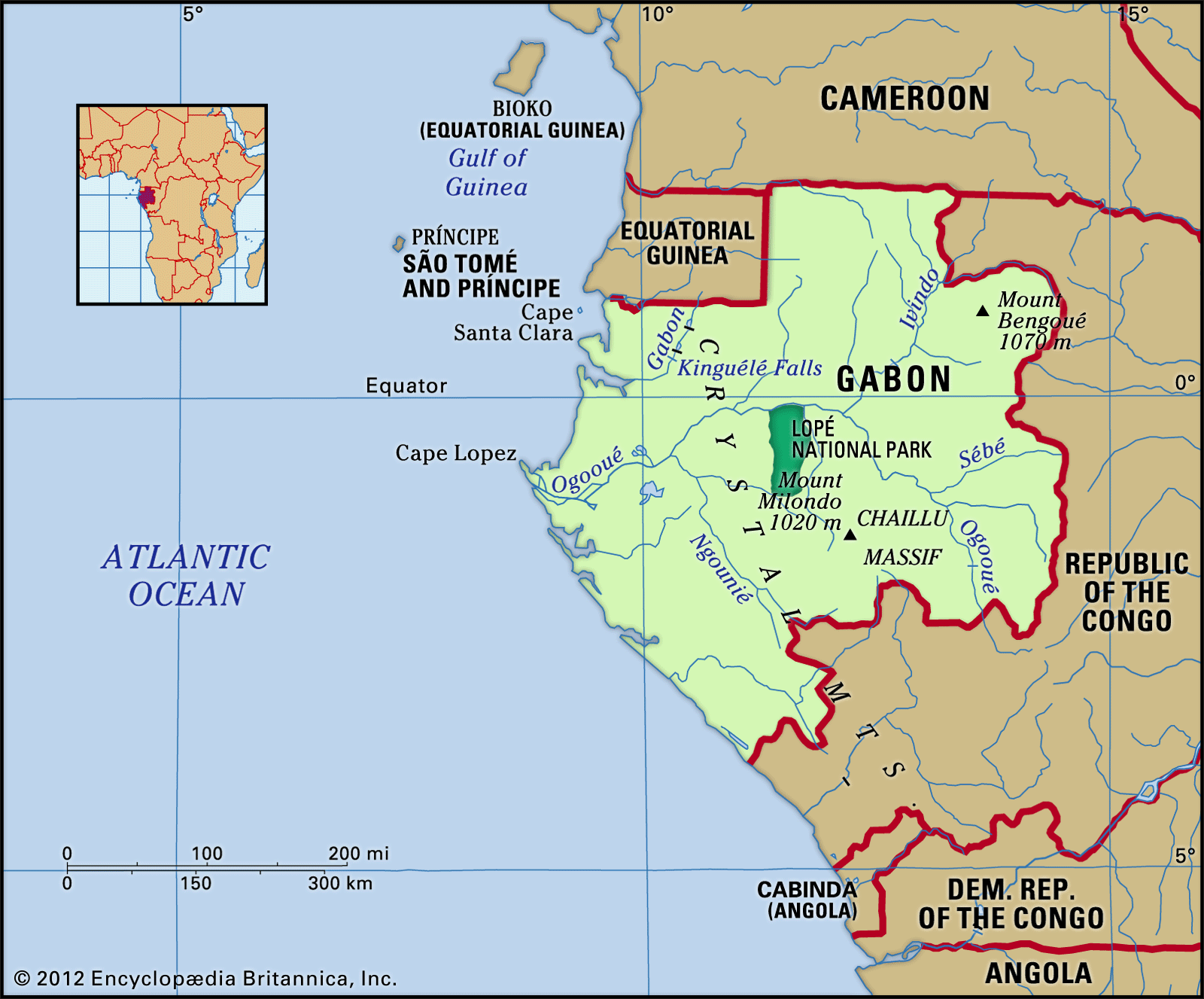
Gabon-map-features-locator

Gabon has a total land area of around 257,000 square km or just under 100,000 square miles, making it around the same size as the UK, New Zealand or the US state of Oregon. Gabon is bordered by Equatorial Guinea to the northwest, Cameroon to the north, the Republic of the Congo on the east and south. Gabon is home to just over 2.1 million people, with the vast majority of those being in Libreville, the largest city and capital, lying on the Komo River, near the Gulf of Guinea. The official language is French, although many Gabonese people speak various mother tongues according to their ethnic group, of which there are over 40.

Gabon is one of the most prosperous countries on the continent, with the fifth highest GDP per capita in all of Africa, while almost 85% of Gabon is covered by rainforests, 11% of which has been dedicated for national parks.

Your hosts, as always, are Luke Kelly @thelukejkelly in Dublin, Ireland, Mark Boyle @markboyle86 in the UK, and Joe Byrne @anbeirneach in Galway, Ireland. Our theme music and other stings come from Thomas O’Boyle @thatthomasfella. 

  • Some great examples of ancient ancestral Gabonese art can be found here.
  • For more on early history and archaeology, see iExplore.
  • You can watch a short documentary on the Punu-Lumbo mask at smarthistory.
  • For more on the life of the Dread Pirate Roberts, see here.
  • Liz Alden Wily has written an entire book on land rights in Gabon, which you can read in full online.
  • Christopher Chamberlain’s paper ‘The Migration of the Fang into Central Gabon during the Nineteenth Century: A New Interpretation’ can be found at JSTOR.
  • Gabon : beyond the colonial legacy by James Franklin Barnes can be read for free on archive.org.
  • For some more modern history (1960s onwards), see this page at the University of Central Arkansas.

Some music related to Gabon:

Thanks to all our patrons who support the show. We really appreciate your continued backing of us. If you want to join them, more information is available at www.patreon.com/80dayspodcast

Djibouti (S4.03)

S04E03 Djibouti Audio

In this episode of 80 Days: An Exploration Podcast, we’ll be talking about Djibouti, a small nation located on the Northeast Coast of the Horn of Africa. Bordered by Eritrea to the North, Ethiopia to the West and Somalia to the south, Djibouti lies on the west side of the Bab-el-Mandeb Strait, the narrowest point of Gulf of Aden.

djcolor

Around 30km across the strait lies Yemen. This chokepoint into the Red Sea, which overlooks the approaches to the Suez Canal, has long made Djibouti a desirable location for naval bases. Dominated by two main groups – the Afar and Issa Somali people, Djibouti today is balanced between these two factions, having endured a protracted civil war in the wake of winning its independence from France in 1977. Occupying a total area of around 23,000 km2 (9,000 sq mi), Djibouti is the third smallest country in continental Africa, and today has a population of around 880,000, the vast majority of whom live in the captial city of Djibouti City. Nearly 94% of the population is Muslim while the remaining 6% are Christian, and official languages are French and Arabic. Djibouti today attracts plenty of foreign investment, and aims to become “Africa’s Dubai.”

This episode, just like all of our recent ones, is supported by our Patreon backers. If you want to help out the show, you can help out by joining us over on www.patreon.com/80dayspodcast to give us whatever you can in terms of financial support and avail of all the lovely awards and extras that entitles you to. If you’re unable to support us financially, you can always leave us a review on Apple Podcasts or wherever you get your podcasts from.

Djibouti

Your hosts, as always, are Luke Kelly @thelukejkelly in Hong Kong, Mark Boyle @markboyle86 in the UK, and Joe Byrne @anbeirneach in Ireland . (Theme music by Thomas O’Boyle @thatthomasfella)


Some further reading:

  • Peter Tyson, writing for PBS Nova, attempts to tackle the “Where Is Punt” question here.
  • Brittanica has loads of additional info on Adal and the Adal Sultanate, discussed by Joe in this episode.
  • You can find additional info on the Ifat Sultanate which succeeded it at openedition.org.
  • The New World Encyclopedia has a wonderful, long form post on the Scramble for Africa, which Djibouti was caught up in.
  • For more info on our old friend Ferdinand de Lesseps and his ill-fated other canal project, you can listen to our season one episode on Panama.
  • We also touch on old friend Vasco Da Gama in this episode. The Christmas special minisode referenced is here.
  • The disastrous Cossack invasion of Sagallo in what was then French Somaliland is profiled in an excellent blog by towardsthegreatocean.com, which Luke quotes from in this episode.
  • Bruno Macaes profiles modern Djibouti in a recent article for Politico, entitled “The most valuable military real estate in the world.”
  • The LSE has a long-form article on Somali regiments during WW1.
  • The Guardian also profiles the “forgotten Muslim heroes who fought for Britain in the trenches” in WW1.
  • You can read the New York Time report on Djibouti’s declaration of independence in 1977 in the paper’s archives here.
  • To learn more about the Djiboutian Civil War, which broke out in 1991, see New World Encyclopedia’s lengthy article on the conflict here.
  • The plans to turn modern Djibouti into “Africa’s Dubai” are detailed by The Culture Trip here.
  • The SCMP journalist James Jeffrey details his experiences with the new Chinese-backed railway revitalisation project here.


Western Sahara (S3.10)

S03E10 – Western Sahara Audio

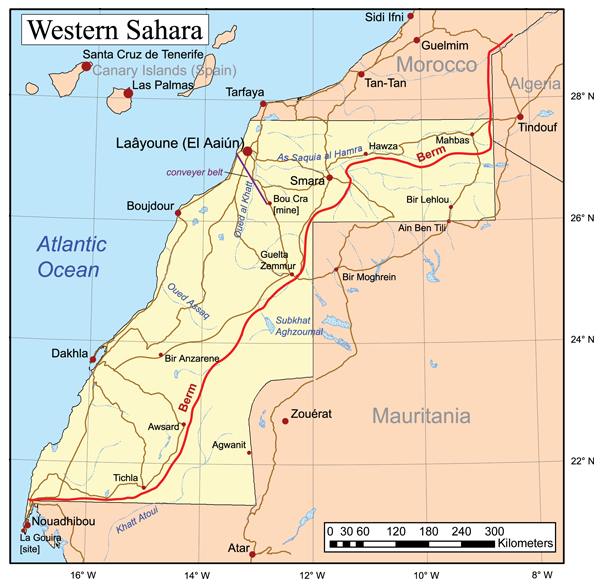
In this episode of 80 Days: an exploration podcast, we’ll be talking about Western Sahara, a disputed territory in North-West Africa. Home to roughly 550,000 people and bordered by Morocco to the north, Algeria to the east, Mauritania to the south and the Atlantic Ocean to the west, Western Sahara is partially controlled by the self-proclaimed Sahrawi Arab Democratic Republic and partially Moroccan-occupied, and is often called ‘Africa’s last colony.’

Map of Western Sahara's position on the west coast of Africa, between Morocco and Mauritania

Map of Western Sahara’s position on the west coast of Africa, between Morocco and Mauritania

First colonised by Spain in 1885, the territory’s sovereignty has been fiercely disputed for decades, particularly since 1975, when Spain officially relinquished its claim over the region. Today it is alternately known as Morocco’s Southern Provinces or the Sahrawi Arab Democratic Republic, however, we’ll be referring to the region as Western Sahara throughout most of this episode. At roughly 260,000 square kilometers or 100,000 square miles, Western Sahara is about the size of the US state of Colorado or just slightly larger than the UK. The territory consists mostly of uninhabitable desert, and nearly 40% of its inhabitants live in Laayoune, the largest city in Western Sahara, while up to 100,000 people from the region are currently living in refugee camps in neighbouring Algeria.

This episode, the Finale of Season 3, is our first Patreon-nominated and voted-on episode. Thanks to Erik Tastepe, in particular, for suggesting this interesting location and to all of you who voted. Join us over on www.patreon.com/80dayspodcast to have a say in the direction of future seasons or get access to various awards.

Your hosts, as always, are Luke Kelly @thelukejkelly in Hong Kong, Mark Boyle @markboyle86 in the UK, and Joe Byrne @anbeirneach in Switzerland . (Theme music by Thomas O’Boyle @thatthomasfella)


In this episode, we carried out an extensive interview with Nick Brooks (@WSaharaProject), a climate scientist, who has worked over many years in Western Sahara, co-directing a project with archaeologist Jo Clarke. This “Western Sahara Project” has led to a recently-published book on the topic (see here). Nick also has a very interesting blog about his time spent there, the politics of the situation and related topics called “Sand and Dust”. Beautiful photo galleries of all the archaeological discoveries from the research project in the desert have been shared on Flickr.

Here are a few things you may want to read/watch more about:

Lesotho (S3.08)

S03E08 Lesotho Audio

In this episode of 80 Days: An Exploration Podcast, we’ll be talking about the Kingdom of Lesotho, previously the British Crown Colony of Basutoland. This small African country is entirely surrounded by South Africa, making it one of only three nations to be contained entirely within another country’s borders. Lesotho is also one of the highest countries in the world, standing an average of 1500 metres above sea level, making it the fifth highest nation in the world by average elevation. Lesotho has a population of around 2 million, and its capital and largest city is Maseru.


At around 30,000 square kilometres, the country is roughly the size of Belgium or the US state of Hawaii. Its combination of high altitude and a relatively cool climate results in it being free of tropical diseases. Rainfall is highly variable, farming is difficult and the country has few natural resources. Sesotho is the national language, but English is the language of business, government and education. 

Your hosts, as always, are Luke Kelly @thelukejkelly in Hong Kong, Mark Boyle @markboyle86 in the UK, and Joe Byrne @anbeirneach in Switzerland . (Theme music by Thomas O’Boyle @thatthomasfella)

LocationLesotho.svg

Above is the location of Lesotho, contained entirely within South Africa.

Here are a few things you may want to read/watch more about:

King_Moshoeshoe_of_the_Basotho_with_his_ministers

Some nice  music (and characteristic dancing, in some cases) we found:

Thanks to Seán Lyons for his interview about his time working in Lesotho with Irish NGO Action Lesotho. A massive thanks too to all of our patrons on Patreon who are supporting season 3. If you’d like to join them and see what rewards are available for supporters, and get a peek behind the curtain check out www.patreon.com/80dayspodcast. We really appreciate the support and input!

Natal, 1497 (Christmas Special)

In the spirit of New Year’s resolutions, we’re asking our listeners to fill out a quick survey to help up improve in 2019. It should only take a minute or two. If you have the time, please click the link below to help out.

Click here to take the listener survey.

In this minisode, Mark takes the lead to tell the story of the discovery of Natal by Portuguese explorer Vasco da Gama on Christmas Day 1497, a story that has intrigued him since he first heard it as a child. The story has a festive aspect to it, and introduces a special guest.

Merry Christmas and a happy new year to our listeners from Mark (@markboyle86), Joe (@anbeirneach) and Luke (@thelukejkelly)! We’ll see you in 2019.

In addition to our theme music by the talented Thomas O’Boyle, this episode featured a lot of music and sound effects, graciously made available for free by contributors at FreeSound.org, Looperman, Free Music Archive and Incompatech, for use under a Creative Commons license, by attribution.

The pieces of music you heard under the text were “Swiftwind” and “How I Used to See the Stars” by Lee Rosevere, licensed under Creative Commons: By Attribution 4.0.

The version of “Silent Night” we used was played by Kevin McLeod (Incompatech.com) and is licenced under Creative Commons: By Attribution 3.0 (http://creativecommons.org/licenses/by/3.0/)

Market sounds from Porto (user Digitopia)Waves in Barcelona (user Mmiron), “Wind, realistic, A” (user InspectorJ), “Wind through trees, 3b” (user spoonbender),  a thunder clap recorded in Pretoria, South Africa (user SoundLover16), Bird ambience in St Lucia Forest, South Africa (user EpicWizard), the sound of glass bells (user Idalize), Trumpets (user Harbour11), “Africa Pavillion Drum Jam” (user RTB45), People laughing, while playing volleyball (user andriala) and the sound of cannons being fired over the Hudson river (user nofeedbak), are all licensed from FreeSound under a Creative Commons by Attribution Licences; while the sound of a crowd in India (by Martin.Sadoux)“Wind and rain in Iceland (user Bashrambali), and the sound of Sleighbells (user Soundstack) were released without copyright.

The following tracks were taken from Looperman: sitar loop (by jensmuse), “Darbuka Dreaming 8” (by planetjazzbass) and “One for Joe (horns)” (by doudei).

Samples of Khoisan people speaking were taken from these YouTube videos of a man in Namibia talking about the use of grass, and a number of people in Botswana speaking to tourists about medicinal plant usage in their community.

The final song is a translation into Portuguese of “Feliz Navidad” by Corrossel (2012) – it can be found here.

Saint Helena (S3.04)

S03E04 Saint Helena Audio

In this episode of season 3 of 80 Days: an exploration podcast, we’ll be talking about Saint Helena, a volcanic tropical island in the South Atlantic Ocean, and one of the most isolated points of land in the world. Saint Helena is more than 2,000 kilometres (1,200 mi) from its nearest mainland neighbour. The nearest port is Namibe in Angola. It was uninhabited up until its discovery by the Portuguese in 1502, and was later taken over by the British. Used for much of its life as an island of exile, its most famous inhabitant was Napoleon Bonaparte, who was exiled there after his defeat at Waterloo. The island today has a population of just over 4500, and is roughly the size of Staten Island in New York or San Marino, at just 121 square kilometeres, or 47 square miles, and its climate is generally mild.

The island is situated in the Western Hemisphere and despite having the same longitude as Cornwall in the United Kingdom, it is classified as being in West Africa by the United Nations.

Its inhabitants, known locally as “Saints”, are the descendants of sailors, settlers and slaves, and are said to be fiercely loyal to the British monarchy. The island’s economy is dependent on British grants and remittances, and up until recently its only link to the outside world was by a Royal Mail Ship, the St Helena, which made a five-day journey from Cape Town in South Africa, every three weeks.

Your hosts, as always, are Luke Kelly @thelukejkelly in Hong Kong, Mark Boyle @markboyle86 in the UK, and Joe Byrne @anbeirneach in Switzerland . (Theme music by Thomas O’Boyle @thatthomasfella)

Flag of Saint Helena  Global position of Saint Helena, with respect to the UK

Here are a few things you may want to read/watch more about:

Music you heard was from the following sources:

Thanks to Fran Hobbs for his insightful interview about life on the island. A massive thanks to all of our patrons on Patreon who are supporting season 3. If you’d like to join them and see what rewards are available for supporters, and get a peek behind the curtain check out www.patreon.com/80dayspodcast. We really appreciate the support and input!